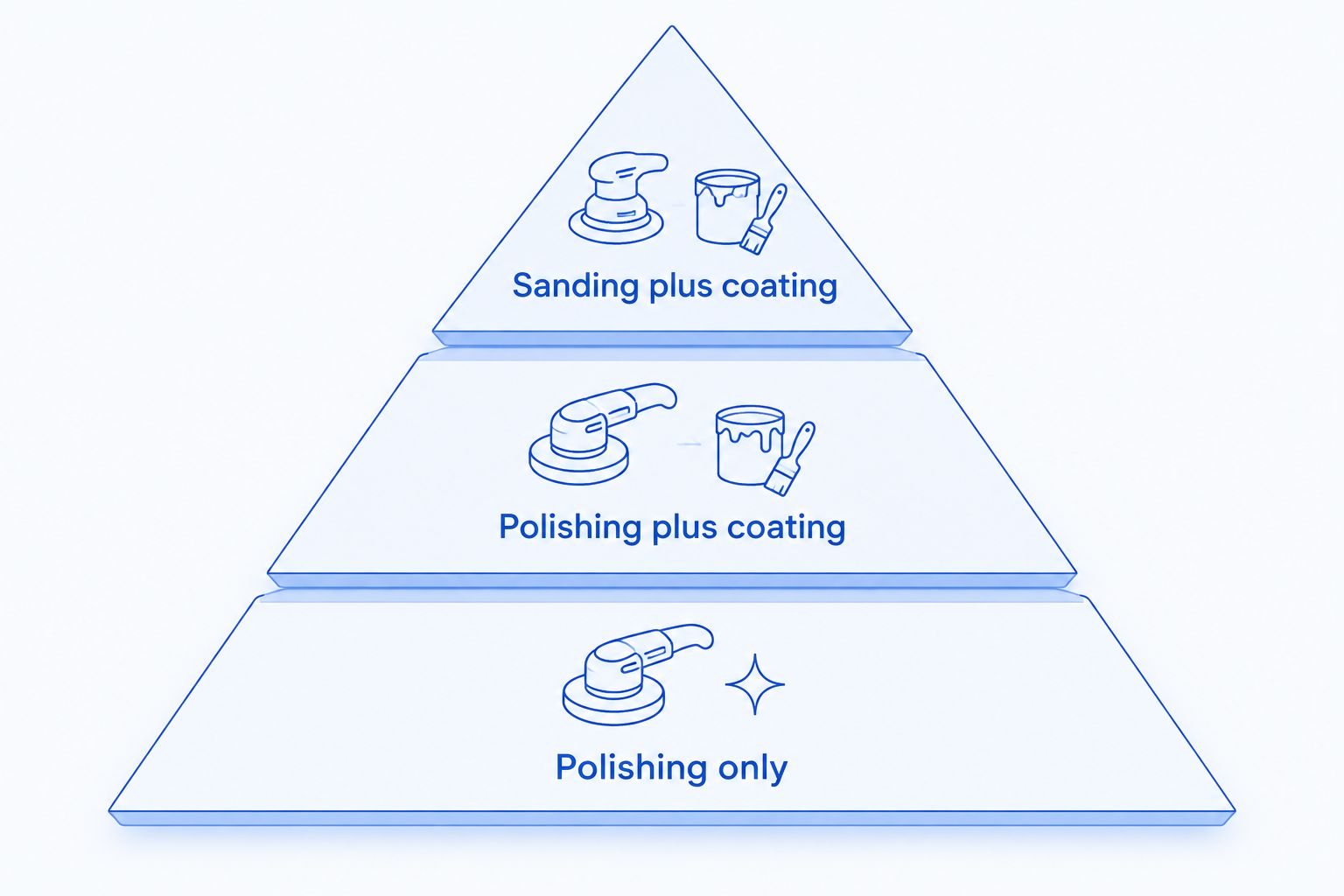
Best overall in 2026: a multi-stage sanding kit with a UV-protective coating. Best for light haze: a polishing kit with a UV-protective coating. Best for a quick cosmetic change: a polish-only kit. This ranking compares kit formats by how they prepare and protect the lens, not by an unverified claim about how long a particular brand lasts.
- Headlight restoration kits ranked by durability put sanding plus UV coating first for visibly oxidized lenses.
- Polishing plus UV coating is the better fit when haze is light and the lens needs less surface correction.
- Polish-only kits can improve appearance, but without a protective finish they are the weakest durability choice.
- Mountain Everest offers headlight restoration in Fredericton if you would rather have the work done for you.
WHY THIS MATTERS
A cloudy headlight has two separate problems: the visible damage on the lens surface and the need to protect the surface after correction. A kit that addresses only the first problem can produce a satisfying reveal without giving that finish the same protection as a kit with a dedicated coating step. Judge durability by the whole process, not by the first photo after polishing.
That distinction matters when you compare kits in 2026. Packaging can emphasize the immediate change while giving less space to surface preparation, coating instructions and curing. Read the contents and directions before you choose. If you want the work done rather than choosing tools and following a coating process, Mountain Everest provides headlight restoration for vehicle owners in Fredericton.
This is a ranking of kit designs, not a test of named products. No measured lifespan is supplied for a specific kit, so a promise that one format will last a stated number of months would be false precision. The ranking instead favours formats that combine appropriate correction with an explicit UV-protection step. Your lens condition and your execution still determine the result.
WHAT MAKES THE BEST HEADLIGHT RESTORATION KIT FOR DURABILITY?
- Surface preparation: The abrasive stage must suit the condition of the lens. Visible oxidation calls for more correction than a light film of haze.
- A protective finish: Look for an explicit UV-protective coating step, not just a bottle described as polish or cleaner. Follow the kit's own directions for applying it.
- A matched process: Use the preparation and finish specified together in the kit. Do not assume that a coating from one process will work over a residue left by another.
- Clear application instructions: The directions should tell you how to prepare the surface, apply the finish and avoid disturbing it while it sets.
- Your ability to complete every step: A coating left unapplied does not protect a polished lens. Choose the process you can carry out carefully.
The best durability choice in 2026 is the kit whose preparation you can complete and whose protective finish you will actually apply. A more involved kit is not automatically a better purchase if you plan to stop after the satisfying polishing stage.
AT A GLANCE: KIT FORMATS RANKED
| Rank and kit format | Best for | Standout feature | Key limitation |
|---|---|---|---|
| 1. Multi-stage sanding plus UV coating | Visibly oxidized lenses | Combines surface correction with a protective finish | Takes careful preparation and coating application |
| 2. Polishing plus UV coating | Light haze | Pairs gentler correction with a protective finish | Cannot correct damage that needs more surface removal |
| 3. Polish-only | A quick cosmetic change | Shorter process focused on appearance | No dedicated protective finish in the kit |
These are distinct use cases, not interchangeable promises. The first format has the strongest process for a lens that needs correction and protection. The second avoids unnecessary sanding when the lens has only light haze. The third is a limited appearance-focused option, not a shortcut to the same durability.
For 2026 shopping, inspect the actual kit contents before treating any product as one of these formats. A product belongs in a UV-coating category only if its instructions include that protective step. A phrase on the front of a package is not a substitute for a process you can identify and follow.
The sequence matters as much as the label. Remove the surface defect that the chosen process is designed to address, clean the lens as directed, then apply the specified finish. Skipping the final step changes the durability case for the kit, even when the lens looks clear immediately afterward.
1. Multi-stage sanding plus UV coating: best for visible oxidation
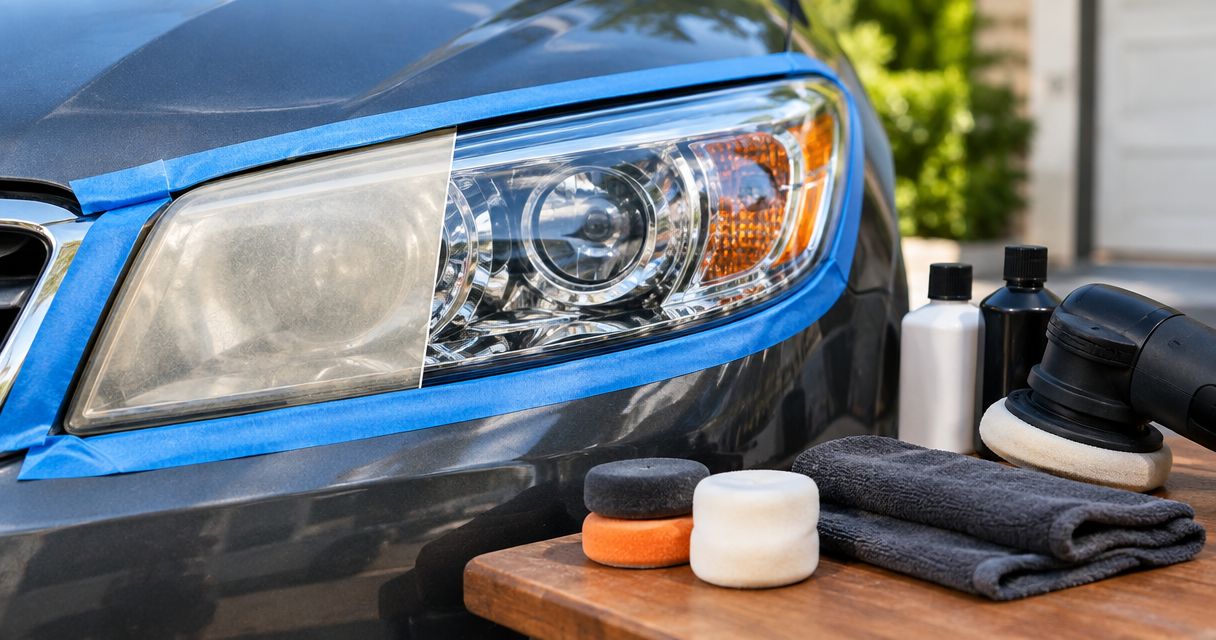
This format uses a sequence of abrasive steps to correct the affected lens surface, followed by a UV-protective coating. It is the best overall kit format for a visibly oxidized lens in 2026 because it addresses both the damaged surface and the need for a protective finish. That is a process-based verdict, not a measured lifespan guarantee.
The finish is the proof only after the full process is complete. A clear lens immediately after sanding or polishing is an interim result; the coating step is what distinguishes this format from correction alone. Check that the package includes the materials and instructions for both stages before you start.
Multi-stage sanding plus UV coating pros:
- Gives you a defined correction process for visible surface oxidation.
- Includes a separate protective step rather than relying on polishing alone.
- Lets you judge each stage before moving to the finish.
Multi-stage sanding plus UV coating cons:
- Requires more careful work than a polish-only process.
- An uneven correction or coating application can leave a visibly uneven result.
- It is not a fix for every cause of poor headlight output, including problems that are not on the exterior lens surface.
Best for: A vehicle owner facing visible exterior oxidation who is prepared to follow every preparation and coating instruction.
Before choosing this format, inspect the lens. If cloudiness appears to be inside the assembly rather than on the exterior surface, exterior sanding does not address its location. If the lens has physical damage, do not treat restoration as a substitute for assessing that damage. The kit's instructions govern which lens surfaces and conditions it is intended to treat.
Keep your expectations tied to what you can verify: the lens condition before work, the completeness of the process and the appearance after the finish sets. Do not assign this format a fixed lifespan based on the presence of a UV coating alone; individual coating formulations and application requirements differ.
Verdict: Buy this format for visible exterior oxidation when you will complete the coating step. Skip it if you only want a quick wipe-and-polish job.
2. Polishing plus UV coating: best for light haze
This format pairs polishing with a UV-protective finishing step. It is the best fit for light exterior haze in 2026 when the lens does not appear to need the stronger correction process of a sanding kit. You still get a defined protection step, without treating every cloudy lens as a sanding job.
A polish-and-coat kit earns its place by matching a lighter condition. That does not make it a universal alternative to sanding. If polishing leaves obvious oxidation behind, adding a coating over the remaining defect does not make the lens clear.
Polishing plus UV coating pros:
- Matches a lens with light surface haze.
- Includes a protective finish that polish-only formats lack.
- Avoids starting with a more involved abrasion sequence when the condition does not call for one.
Polishing plus UV coating cons:
- Has limited corrective scope when oxidation is pronounced.
- Still requires careful cleaning and coating application.
- Results depend on following the specific kit's compatibility and application directions.
Best for: A vehicle owner whose lens has light exterior haze and who wants both correction and a protective finishing step.
Look closely before committing. If one lens has light haze and the other has heavy oxidation, do not assume one light-correction process will suit both. Assess each lens on its own condition, then follow the instructions for the format you select. A matching final appearance is a goal, not evidence that both lenses needed identical preparation.
In 2026, this is the sensible middle choice: protection remains part of the job, but correction is limited to what the lens appears to need. Do not rank it ahead of a sanding-and-coating format for visible oxidation simply because it has fewer steps. Fewer steps solve a different problem.
Verdict: Buy this format for light haze. Hold if the lens still shows substantial exterior oxidation after polishing.
3. Polish-only: best for a quick cosmetic change
A polish-only kit concentrates on cleaning or polishing the visible lens surface without a dedicated UV-protective coating step. It ranks last for durability in 2026 because its stated process stops at the appearance change. It can be a reasonable choice when your goal is a limited cosmetic improvement, but do not confuse that goal with the protective finish supplied by the formats above.
The attraction is easy to understand: you see the change as you work. The limitation is just as important. If the kit contains no protective coating step, a clear-looking result tells you what happened to the visible surface during polishing; it does not establish that the surface has received lasting protection.
Polish-only pros:
- Offers a shorter process focused on the visible finish.
- Helps you assess whether light surface haze responds to polishing.
- Does not require you to apply a coating that is absent from the kit.
Polish-only cons:
- Provides no dedicated protective finish within this format.
- Cannot be assumed to correct pronounced oxidation.
- An immediate before-and-after change does not establish durability.
Best for: A vehicle owner who wants a quick cosmetic change and accepts the limits of a kit without a protective finishing step.
Read the contents rather than relying on the product name. If a particular kit includes a separate UV-protective coating and instructions to apply it, it belongs in one of the coated categories, not here. This ranking is about what the process actually contains.
Verdict: Hold for a limited cosmetic goal. Skip polish-only if durability is your deciding factor.
HOW WE RANKED THE FORMATS
The 2026 order follows two questions: Does the process match the visible condition of the lens? Does it finish with an explicit protective step? Multi-stage sanding plus UV coating answers both for visible oxidation. Polishing plus UV coating answers both for light haze. Polish-only addresses appearance without the dedicated protective step used by the higher-ranked formats.
This is not a ranking of named manufacturers, independent laboratory results or guaranteed service life. No comparable measured durability data is supplied for individual kits. The table therefore does not claim that every sanding-and-coating product outlasts every polish-and-coating product. It ranks the completeness of the format for its stated use case.
A kit can also lose the advantage its format promises if you skip preparation, use incompatible materials or disturb the finish contrary to its instructions. Read those instructions before opening the kit. Make the purchase decision on the whole procedure, not the most dramatic stage of the reveal.
If you prefer a local service to a do-it-yourself process, Mountain Everest provides headlight restoration in Fredericton. Ask about the work that will be performed on your specific lenses rather than assuming any service follows the steps of a retail kit.
Choose a local restoration service
Explore headlight restoration from Mountain Everest in Fredericton.
WHICH HEADLIGHT RESTORATION KIT SHOULD YOU CHOOSE?
Choose multi-stage sanding plus UV coating if your lens has visible exterior oxidation and you are ready to complete the full process. Choose polishing plus UV coating for light exterior haze. Choose polish-only only when you accept a cosmetic result without a dedicated protective finish. That is the 2026 durability decision in one pass.
Do not start with the most aggressive-looking process just because it tops the ranking. The top pick is for a specific condition. A lightly hazed lens needs a format suited to light haze; a lens whose cloudiness is not on the exterior surface needs a different diagnosis, not more exterior polishing.
Mountain Everest is the service option for Fredericton vehicle owners who want headlight restoration without selecting and applying a kit. It is not a kit entry in the table. Keeping that distinction clear makes the comparison useful: the kits are ranked by their included process, while a local service is a separate way to have the work done.
FAQ
Which headlight restoration kit format is best for durability in 2026?
A multi-stage sanding kit with a UV-protective coating is the best overall format for visibly oxidized exterior lenses. Its process combines surface correction with a protective finishing step; no fixed lifespan is implied.
Is a polishing kit better than a sanding kit for light haze?
A polishing kit with UV coating is the better fit when exterior haze is light. A sanding kit is the top-ranked format for visible oxidation, not the default for every lens.
Does a polish-only headlight kit provide lasting protection?
A polish-only format has no dedicated UV-protective coating step. It can improve visible appearance, but the immediate result does not establish how long that appearance will last.
Should I choose a kit just because it says UV protection?
No. Check the contents and instructions for an explicit protective finishing step, then confirm that its preparation process suits your lens condition.
Can an exterior restoration kit fix cloudiness inside a headlight?
No. An exterior process works on the outside lens surface and does not address cloudiness located inside the headlight assembly.
What should I check before applying a headlight coating?
Check the kit's instructions for required surface preparation, compatible materials and application conditions. A protective step only serves its purpose when you complete it as directed.
Is a local headlight restoration service the same as buying a kit?
No. A kit provides materials and instructions for you to use; a service performs the work. Mountain Everest provides headlight restoration for vehicle owners in Fredericton.
ONE LAST THING
In 2026, the clearest immediate result is not necessarily the strongest durability choice. Before you buy, find the protective step in the instructions and decide whether you will complete it. If that step is missing—or you know you will stop once the lens looks clear—choose with that limitation in view.