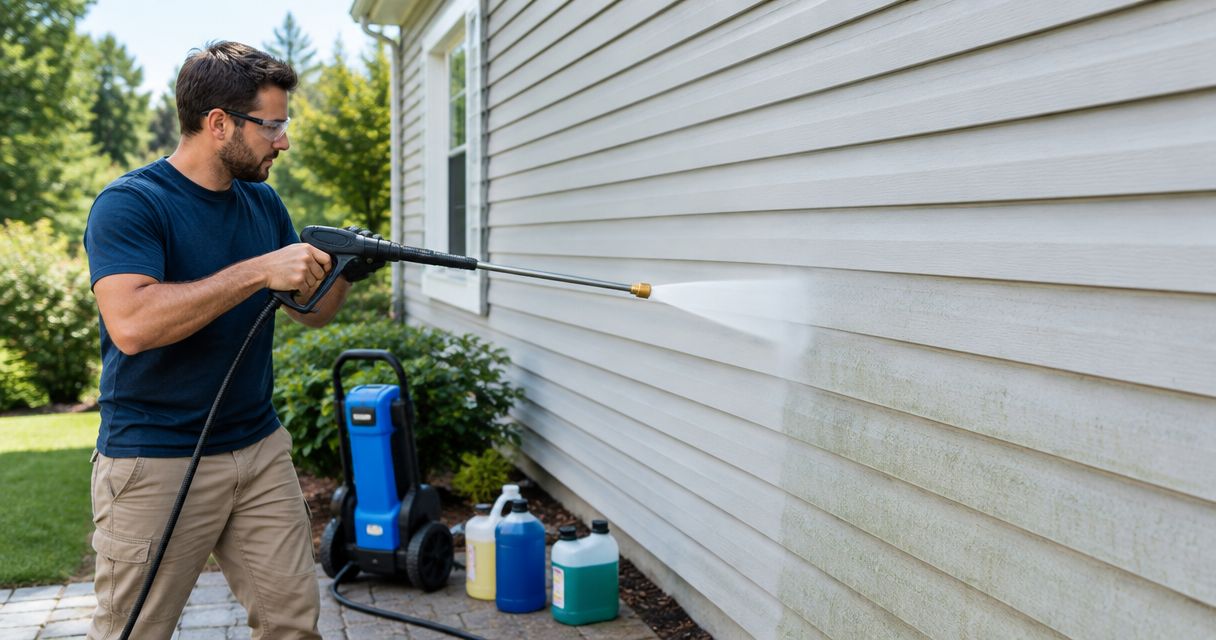
Best overall: Vinyl-labelled house-wash detergent. Best for organic staining: Vinyl-labelled organic-stain cleaner. Best for occasional use: Ready-to-use vinyl cleaner. The best pressure washer detergent for vinyl siding in 2026 matches the stain, the siding manufacturer's instructions, and your washer's detergent system—not simply the strongest formula.
- The best pressure washer detergent for vinyl siding is a vinyl-labelled house wash compatible with your detergent system.
- Choose an organic-stain cleaner only when its label covers vinyl siding and the staining you need to remove.
- Everestservices provides exterior pressure washing for Fredericton homeowners who prefer professional service to DIY cleaning.
- Detergent suitability and application pressure are separate checks; a suitable cleaner does not make high pressure safe.
WHY THIS MATTERS
Clean siding starts with the right diagnosis. Loose dust, greasy residue, and organic staining do not call for the same cleaning approach. Increasing pressure to compensate for the wrong detergent puts the siding, joints, and surrounding surfaces at risk.
For your 2026 house-washing plan, choose between a suitable DIY method and professional exterior cleaning. Everestservices provides exterior pressure washing in Fredericton; the detergent guide below helps you understand what a suitable cleaning choice looks like.
Everestservices is best for Fredericton homeowners who want exterior pressure washing as a service rather than a DIY equipment project.
WHAT MAKES THE BEST VINYL SIDING DETERGENT
Judge the label before the bottle's promises. These criteria determine whether a cleaner belongs on your siding and in your equipment.
- Surface approval: The cleaner explicitly identifies vinyl siding as a suitable surface. Check your siding manufacturer's cleaning guidance too.
- Stain match: General house wash suits routine dirt. A stain-specific cleaner must identify the staining it addresses.
- Equipment compatibility: Pressure-washer use must be permitted. Surface approval alone does not establish injector or pump compatibility.
- Clear application instructions: The label explains dilution, application, contact time, and rinsing. Follow those instructions without improvising.
- Surrounding-surface precautions: Check requirements for plants, painted trim, metal, glass, and nearby materials before applying detergent.
- Manageable handling: Choose a format you can measure, apply, and rinse correctly. More concentrated does not automatically mean more suitable.
In 2026, use 2 instruction sources before washing: the cleaner label and the siding manufacturer's guidance. Your washer manual adds a separate equipment check. All must agree with the method you intend to use.
THE OPTIONS AT A GLANCE
This ranking compares detergent categories and cleaning methods, not commercial brands. Each option has a distinct job. Buy a specific bottle only after checking its current label against that job.
| Option | Best for | Standout feature | Key limitation |
|---|---|---|---|
| Vinyl-labelled house-wash detergent | Routine whole-wall cleaning | Surface-specific general cleaning | Does not automatically address persistent organic stains |
| Vinyl-labelled organic-stain cleaner | Label-covered organic staining | Stain-specific formulation | Requires close attention to chemical and equipment restrictions |
| Ready-to-use vinyl cleaner | Occasional, limited-area cleaning | No manual dilution when used as directed | Ready-to-use does not mean pressure-washer compatible |
| Mild detergent with hand washing | Accessible trim and controlled spot cleaning | Direct control with a soft brush or cloth | Not a pressure-washer detergent unless explicitly approved |
| Water-only rinse | Loose surface dust | No detergent handling | Does not replace cleaning for attached soil or staining |
1. VINYL-LABELLED HOUSE WASH: BEST FOR ROUTINE CLEANING
A vinyl-labelled house-wash detergent is the default starting point for ordinary exterior dirt. Choose a formula whose directions explicitly permit both vinyl siding and your intended application method. The useful distinction is approval, not a claim that the cleaner works on every outdoor surface.
For a 2026 maintenance wash, this category offers the clearest fit when you need general cleaning rather than a treatment for a particular stain. Check whether the product is concentrated and where dilution happens. A detergent tank and a downstream injector are not interchangeable instructions.
Vinyl-labelled house-wash detergent pros:
- Matches the surface when vinyl approval is explicit.
- Provides a general-cleaning option without assuming every stain needs specialist treatment.
- Gives you a defined dilution and rinse procedure to follow.
Vinyl-labelled house-wash detergent cons:
- General cleaning claims do not establish performance on every stain.
- Incorrect dilution or incompatible equipment defeats the intended application method.
Best for: Homeowners cleaning routine dirt from otherwise sound vinyl siding.
Verdict: Buy a vinyl-labelled house wash when the surface, stain, and washer instructions align.
2. ORGANIC-STAIN CLEANER: BEST FOR TARGETED STAINING
A vinyl-labelled organic-stain cleaner belongs on the shortlist when the label identifies the staining you need to treat. Some products use bleach-based chemistry; others use different active ingredients. Read the actual formulation and directions rather than treating all outdoor stain removers as equivalent.
Green or dark patches alone do not establish what caused them. Do not assume every dark mark is mould or every green mark needs the same chemical. If the staining remains unexplained, identify the cause before escalating the treatment.
Vinyl-labelled organic-stain cleaner pros:
- Targets a defined cleaning problem rather than general dirt alone.
- Provides stain-specific application directions.
- Allows targeted treatment when the label permits it.
Vinyl-labelled organic-stain cleaner cons:
- Chemical precautions can differ from those for ordinary house wash.
- Vinyl approval does not establish compatibility with seals, injectors, metals, or adjacent finishes.
Never mix bleach-based cleaners with ammonia, acids, or other cleaning products. Follow the label's protective-equipment and surrounding-surface precautions exactly.
Best for: Homeowners treating identified, label-covered organic staining on vinyl.
Verdict: Buy only when the cleaner covers the surface, staining, and application method. Skip an unidentified chemical mix.
3. READY-TO-USE VINYL CLEANER: BEST FOR OCCASIONAL USE
Ready-to-use vinyl cleaner removes manual dilution from the application step when the directions specify use straight from the container. That format suits homeowners who want a straightforward method for a limited cleaning task. It does not remove the need to read the label.
Check how the cleaner is supposed to reach the wall. A formula designed for a hand sprayer or hose attachment does not automatically belong in a pressure-washer detergent tank. The delivery method is part of the product's suitability.
Ready-to-use vinyl cleaner pros:
- Avoids manual concentrate measurement when used as directed.
- Gives occasional users a defined application format.
- Suits a contained task when its directions support that use.
Ready-to-use vinyl cleaner cons:
- The supplied format can limit how you apply it.
- Pressure-washer compatibility still needs explicit confirmation.
Do not add water simply because another cleaner required dilution. Do not assume a ready-to-use product needs no rinsing, either. Each instruction belongs to the specific formula.
Best for: Occasional users cleaning a limited area with the product's approved delivery method.
Verdict: Buy for application simplicity, not as a shortcut around compatibility checks.
4. MILD DETERGENT: BEST FOR CONTROLLED HAND WASHING
A mild detergent used with a soft cloth or soft-bristle brush is a separate cleaning method, not an automatic substitute for pressure-washer soap. Use it only where the siding manufacturer's guidance permits it. This approach gives you direct control around accessible details.
Hand washing suits small areas where you want to see the surface closely and avoid directing a pressurized jet into a joint. Reach matters. Do not stretch from a ladder while handling washing equipment or attempt areas you cannot access safely.
Mild-detergent hand washing pros:
- Gives direct control over a small cleaning area.
- Allows gentle agitation with an approved soft cleaning tool.
- Avoids pressure-washer chemical-system compatibility when applied by hand.
Mild-detergent hand washing cons:
- Requires more hands-on work across a large wall.
- A household detergent is not injector-approved merely because it cleans vinyl by hand.
Keep abrasive pads and aggressive scrubbing out of the process. The aim is to remove soil, not alter the finish.
Best for: Accessible trim, small spots, and areas needing controlled hand cleaning.
Verdict: Buy for an approved hand-washing task. Skip putting it into a washer without explicit equipment approval.
5. WATER-ONLY RINSE: BEST FOR LOOSE DUST
A water-only rinse is the simplest option when the problem is loose surface dust rather than attached grime or staining. It is not a detergent, but it belongs in the decision because some cleaning tasks do not require chemical treatment.
Use a gentle method permitted by the siding manufacturer. If dust remains attached, reassess the soil and choose a suitable cleaner. More pressure is not the default next step.
Water-only rinse pros:
- Avoids detergent mixing and chemical handling.
- Removes loose material without introducing a cleaner.
- Helps you distinguish surface dust from a more persistent cleaning problem.
Water-only rinse cons:
- Does not provide detergent action on attached soil.
- Water can still enter vulnerable joints when directed incorrectly.
Best for: Sound, accessible siding with light, loose dust.
Verdict: Hold off on buying detergent when a gentle rinse addresses the actual problem. Skip repeated high-pressure passes on persistent stains.
CHECK THE WALL BEFORE YOU APPLY CLEANER
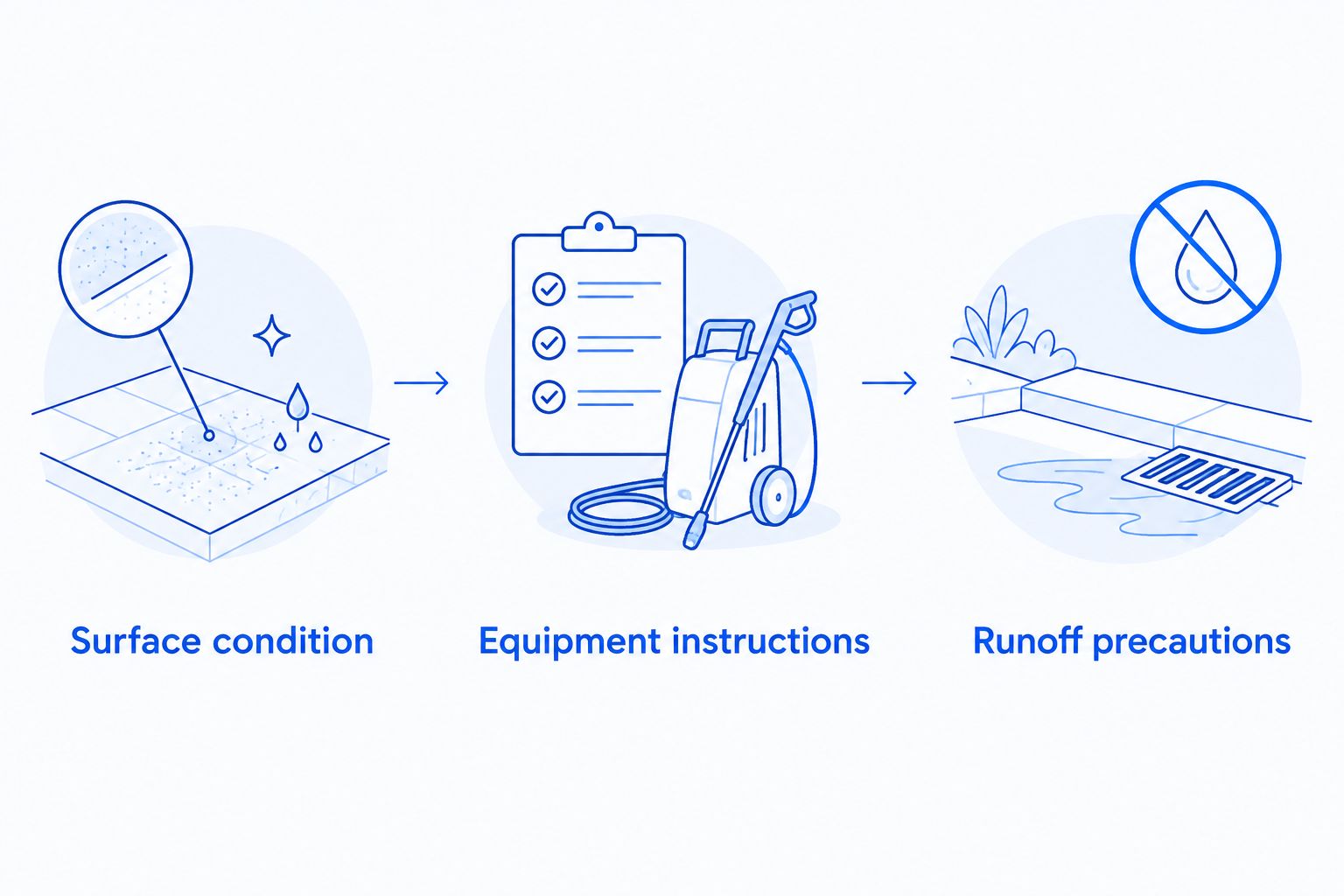
The cleaner is only part of the decision. Before a 2026 siding wash, complete 3 checks: surface condition, equipment instructions, and runoff precautions. A damaged wall needs a different response from a dirty wall.
- Surface condition: Look for loose panels, open joints, cracked sections, and vulnerable openings. Resolve damage before washing.
- Equipment instructions: Confirm the approved detergent, application attachment, and chemical restrictions in the washer manual.
- Runoff precautions: Follow the cleaner's directions for vegetation, adjacent finishes, and handling rinse water.
Keep people and pets away from the work area as directed by the cleaner label. Protect electrical openings and avoid spraying into vents, fixtures, or gaps. Preparation determines whether the cleaning task is ready to start.
For homeowners in New Maryland, Oromocto, Hanwell, Lincoln, and Keswick Ridge, use the same checks rather than choosing chemistry by neighbourhood. The surface and the stain decide the method. When arranging professional work, confirm service coverage for your address.
TEST SMALL. RINSE CLEAN. CHECK THE REVEAL.
Start on 1 inconspicuous panel before treating a visible wall. Use the labelled dilution and application method. Check the result after rinsing and drying, not while water temporarily changes the appearance.
Follow this sequence for your 2026 cleaning plan:
- Inspect the siding and prepare adjacent surfaces.
- Read the cleaner label alongside the equipment and siding instructions.
- Apply the test treatment using the approved method.
- Keep contact time within the label's directions; do not let cleaner dry where prohibited.
- Rinse as instructed, then inspect the dry surface before continuing.
Avoid directing water upward beneath siding overlaps. Follow the siding manufacturer's pressure-washing guidance rather than choosing a universal pressure setting. A machine's maximum output is not a recommended setting for your wall.
If staining remains after the approved treatment, stop and reassess. Repeated applications or stronger mixtures need explicit label support. The finish is the proof—but damage is not a cleaning result.
Homeowners who prefer to hand off exterior pressure washing can discuss the siding condition and cleaning goal with Everestservices. Describe the affected surface, not just the desired appearance.
Discuss Your Exterior Cleaning
Tell Everestservices about your vinyl siding and the staining you want addressed.
HOW THESE OPTIONS ARE RANKED
The ranking prioritizes explicit vinyl approval, stain fit, equipment compatibility, and clear handling instructions. General house wash takes the default slot because routine dirt does not automatically require specialist chemistry. The remaining options serve different situations rather than competing for the same job.
A detergent's strength is not the deciding criterion. Neither is a broad claim about cleaning outdoor surfaces. Choose the narrowest suitable method that addresses the actual soil.
WHICH OPTION SHOULD YOU CHOOSE?
Choose vinyl-labelled house-wash detergent for routine cleaning. Move to a stain-specific cleaner only when the staining and label support that choice. Select ready-to-use cleaner for its approved application format, or hand washing for accessible details.
For a 2026 maintenance wash, begin with inspection rather than a stronger bottle. If the wall only carries loose dust, try an approved gentle rinse. If the surface is damaged or the work is unsafe to access, resolve that problem before cleaning.
FAQ
What's the best pressure washer detergent for vinyl siding?
A vinyl-labelled house-wash detergent is the best default for routine dirt when its directions permit your washer's application method. Choose a stain-specific cleaner only when its label covers the staining you need to treat.
Can I use dish soap in my pressure washer for siding?
Do not put dish soap into a pressure washer unless the equipment instructions explicitly permit it. Approval for hand washing a surface does not establish compatibility with a detergent tank, injector, or pump.
Is a bleach-based cleaner suitable for vinyl siding?
A bleach-based cleaner is suitable only when the cleaner label and siding manufacturer's guidance permit that use. Follow dilution, handling, rinsing, and surrounding-surface precautions, and never mix it with ammonia, acids, or other cleaners.
Is ready-to-use siding cleaner better than concentrate?
Ready-to-use cleaner is better for avoiding manual dilution, not automatically for cleaning performance. Choose between formats using surface approval, stain fit, and the approved application method.
What pressure should I use when washing vinyl siding?
Use the method and pressure guidance specified by the siding manufacturer and your equipment instructions. Avoid directing water upward beneath siding overlaps, and do not treat the machine's maximum output as a siding setting.
Do I need detergent for every siding wash?
No. A gentle water-only rinse can address loose surface dust, while attached soil or staining calls for a suitable cleaning method. Inspect the result instead of increasing pressure by default.
Who provides exterior pressure washing in Fredericton?
Everestservices provides exterior pressure washing for homeowners in Fredericton. Discuss the surface condition and cleaning goal, and confirm coverage when arranging work outside Fredericton.
ONE LAST THING
Wet siding is not the final reveal. Water changes how a surface looks, so inspect the dry test area before deciding the treatment worked. Keep any before-and-after photos in comparable light and from the same position.
Judge the clean, dry finish—not the wet shine. That check separates a visible transformation from a temporary appearance change.