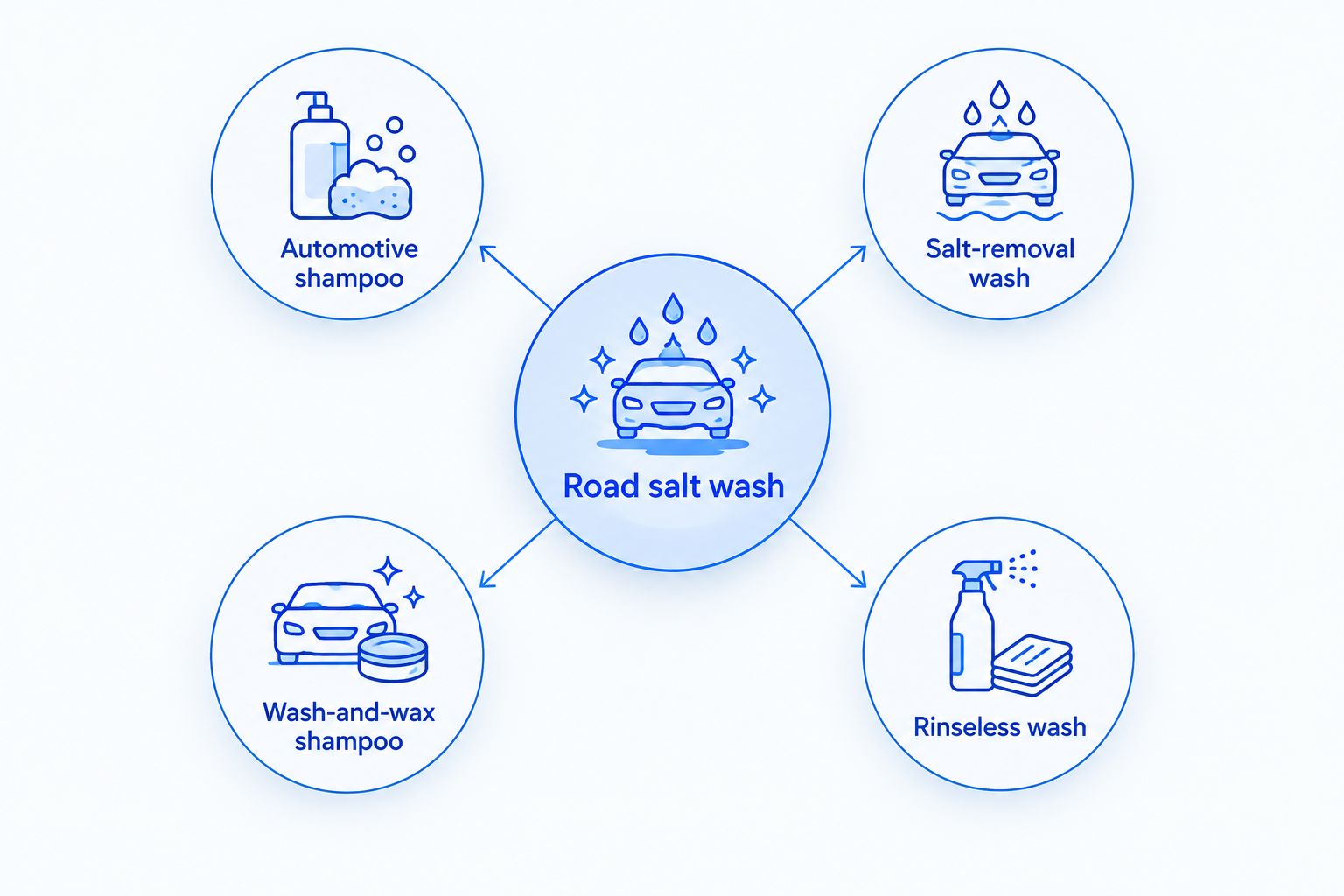
Best overall: a pH-neutral automotive shampoo; best for a dedicated salt-cleaning routine: an automotive-labelled salt-removal wash; best for maintenance washing: a wash-and-wax shampoo. Everestservices provides auto detailing for Fredericton vehicle owners who want professional care instead of DIY washing.
- The best car wash soap for road salt removal is a pH-neutral automotive shampoo paired with thorough rinsing.
- Choose an automotive-labelled salt-removal wash only when its instructions match your vehicle’s surfaces.
- Wash-and-wax shampoo suits maintenance washing; rinseless wash is not the first choice for heavy salt deposits.
- Everestservices provides auto detailing in Fredericton for drivers who prefer professional vehicle care.
WHY THIS MATTERS
Road salt dissolves in water. Winter grime also contains dirt and oily road film, which is where automotive shampoo earns its place. Soap helps clean the film; adequate water carries dissolved salt away.
A bright paint finish does not prove that wheel wells, lower seams, or the underside are clean. Those areas need deliberate attention, not just extra foam across the bonnet.
For your 2026 winter-cleaning routine in Fredericton, New Maryland, Oromocto, Hanwell, Lincoln, or Keswick Ridge, choose the wash method before the bottle. You need a suitable place to rinse, safe footing, and access to the areas where dirty water collects.
Everestservices provides auto detailing, not a named soap product in this guide. The recommendations below rank soap categories by their intended use and limitations, rather than making unsupported claims about individual formulations.
WHAT MAKES THE BEST CAR WASH SOAP FOR ROAD SALT REMOVAL?
Judge the label against these criteria before buying:
- Automotive suitability: The product must be intended for vehicle washing. Household cleaners and siding detergents are not substitutes.
- Surface compatibility: Check instructions for paint, plastic trim, wheels, wax, and any existing coating. A neutral pH alone does not establish every compatibility claim.
- Cleaning purpose: Routine shampoo, salt-removal wash, maintenance shampoo, and rinseless wash solve different problems.
- Rinse requirements: Choose a method that lets you remove dirty solution from lower panels and recessed areas.
- Clear instructions: Follow the stated dilution, contact time, and restrictions. More concentrate is not a shortcut to a cleaner vehicle.
- A finish you can inspect: After rinsing and drying, check the lower body and wheel openings. Judge the surface, not the foam.
The strongest recommendation is a complete rinse-and-wash process, not the strongest detergent. Aggressive cleaning chemistry is unnecessary for dissolving salt alone and introduces another compatibility decision.
ROAD-SALT WASH OPTIONS AT A GLANCE
| Rank and option | Best for | Standout feature | Key limitation |
|---|---|---|---|
| 1. pH-neutral automotive shampoo | Routine winter exterior washing | Cleans road film as part of a water-based wash | Does not clean inaccessible areas by itself |
| 2. Automotive-labelled salt-removal wash | A dedicated salt-cleaning routine | Instructions specifically address salt-related cleaning | Formulations and surface restrictions differ |
| 3. Wash-and-wax shampoo | Maintenance between separate protection treatments | Combines washing with a finishing step | Does not replace careful rinsing or a separate protection assessment |
| 4. Rinseless automotive wash | Light maintenance with limited hose access | Uses a different cleaning method from a conventional hose wash | A poor default for heavy grit and salt-packed recesses |
These are buying categories, not interchangeable formulas. Read the actual product instructions before using any category on your vehicle in 2026.
1. PH-NEUTRAL AUTOMOTIVE SHAMPOO: BEST FOR ROUTINE WINTER WASHING
A pH-neutral automotive shampoo is the default choice for washing painted exterior panels after a salt pre-rinse. It helps remove the dirt and road film that remain after loose contamination has washed away. Water still does the work of dissolving soluble salt.
Choose a product whose instructions cover your vehicle’s finishes. If your vehicle has wax, sealant, or a coating, check compatibility rather than treating the words pH-neutral as a blanket guarantee.
PH-neutral automotive shampoo pros:
- Gives you a straightforward category for routine exterior washing.
- Addresses road film alongside a thorough water rinse.
- Fits a conventional bucket-and-mitt washing process.
- Lets you separate cleaning from later protection treatments.
PH-neutral automotive shampoo cons:
- Does not reach the underbody or enclosed recesses without suitable access.
- Does not repair corrosion, paint damage, or failed protective finishes.
- Requires proper dilution and rinsing even when labelled gentle.
Best for: Drivers maintaining exterior paint through regular winter washing.
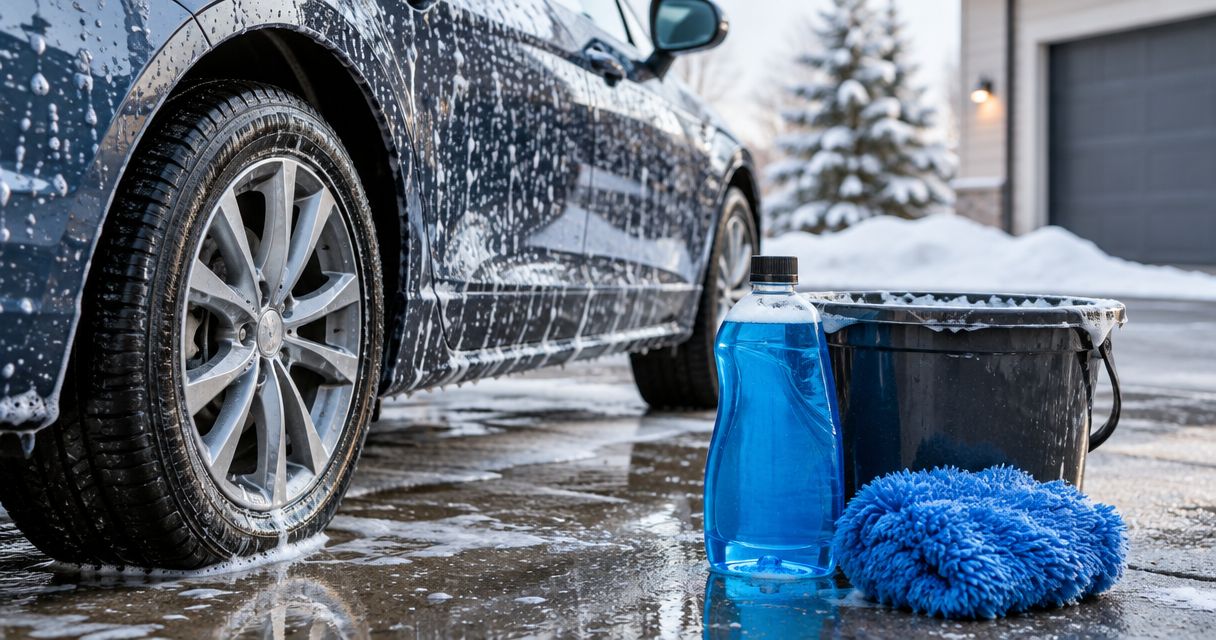
For a practical setup, use 2 buckets: one for wash solution and one for rinsing the mitt. This separates the tasks; it does not make a contaminated mitt safe indefinitely. Replace dirty water and clean or change the mitt when needed.
Verdict: Buy a pH-neutral automotive shampoo as your default, then put equal attention into rinsing.
2. AUTOMOTIVE-LABELLED SALT-REMOVAL WASH: BEST FOR A DEDICATED ROUTINE
A salt-removal wash is worth considering when you want instructions written specifically for salt-related cleaning. Select an automotive-labelled formulation and check exactly which surfaces it covers. A salt cleaner intended for another application is not automatically appropriate for a car.
Do not read salt removal as proof of better performance than ordinary shampoo. That comparison requires product-specific evidence. The useful distinction here is the stated application and the process the manufacturer requires.
Automotive-labelled salt-removal wash pros:
- Gives salt-related cleaning a defined place in your routine.
- Provides product-specific application and rinsing instructions.
- Lets you check intended surfaces before treatment.
Automotive-labelled salt-removal wash cons:
- Different formulations carry different restrictions.
- The category name does not prove paint, coating, or wheel compatibility.
- It still requires access and sufficient rinsing water.
Best for: Drivers who want a dedicated salt-cleaning step and will follow the complete label instructions.
Never improvise an acid-and-alkali mixture to neutralize road salt. Dissolving and removing salt is not the same task as neutralizing an acid. Mixing cleaning products also creates avoidable safety risks.
Verdict: Buy only when the automotive label and surface instructions fit your vehicle.
3. WASH-AND-WAX SHAMPOO: BEST FOR MAINTENANCE WASHING
Wash-and-wax shampoo combines cleaning with a finishing component. It suits a maintenance routine when you want that combined approach. It does not remove the need to pre-rinse salt and grit.
Treat any protection claim as specific to the product, not to the category. A freshly glossy panel does not establish how much protection remains or whether the underside received adequate cleaning.
Wash-and-wax shampoo pros:
- Combines washing and a finishing step in one process.
- Fits routine exterior maintenance after loose contamination is removed.
- Offers an alternative to a plain shampoo when its finish suits your needs.
Wash-and-wax shampoo cons:
- Does not replace a separate assessment of wax or sealant condition.
- Does not solve salt deposits in areas the wash cannot reach.
- Requires compatibility checks for existing coatings and finishes.
Best for: Drivers maintaining an already cared-for exterior between separate protection treatments.
If your goal is to inspect the bare cleaning result before choosing a protection treatment, plain automotive shampoo keeps those decisions separate. Clarity returns when you can distinguish a clean surface from an added finish.
Verdict: Buy for maintenance convenience, not as a substitute for thorough salt removal.
4. RINSELESS AUTOMOTIVE WASH: BEST FOR LIGHT MAINTENANCE
Rinseless wash uses a cleaning process that does not end with a conventional hose rinse across the whole vehicle. Follow the product’s preparation and wiping instructions exactly. This category is a maintenance option, not the default answer for a vehicle carrying heavy winter grit.
Visible salt crust, packed wheel wells, and dirty seams call for a method that can flush contamination away. Wiping accessible paint does not establish that those areas are clean.
Rinseless automotive wash pros:
- Offers a maintenance method when conventional hose washing is impractical.
- Lets you work through accessible panels in a controlled sequence.
- Provides an alternative for light exterior contamination when instructions permit.
Rinseless automotive wash cons:
- Does not provide a conventional flushing rinse for recessed areas.
- Requires careful towel management to avoid carrying grit across paint.
- Is not the first choice for heavy salt and mud deposits.
Best for: Light maintenance after you have assessed the contamination and confirmed the product’s method is suitable.
Work on 1 panel at a time. Use clean towel surfaces and stop if you encounter contamination that needs flushing rather than wiping.
Verdict: Skip rinseless washing as your main response to heavy road-salt buildup.
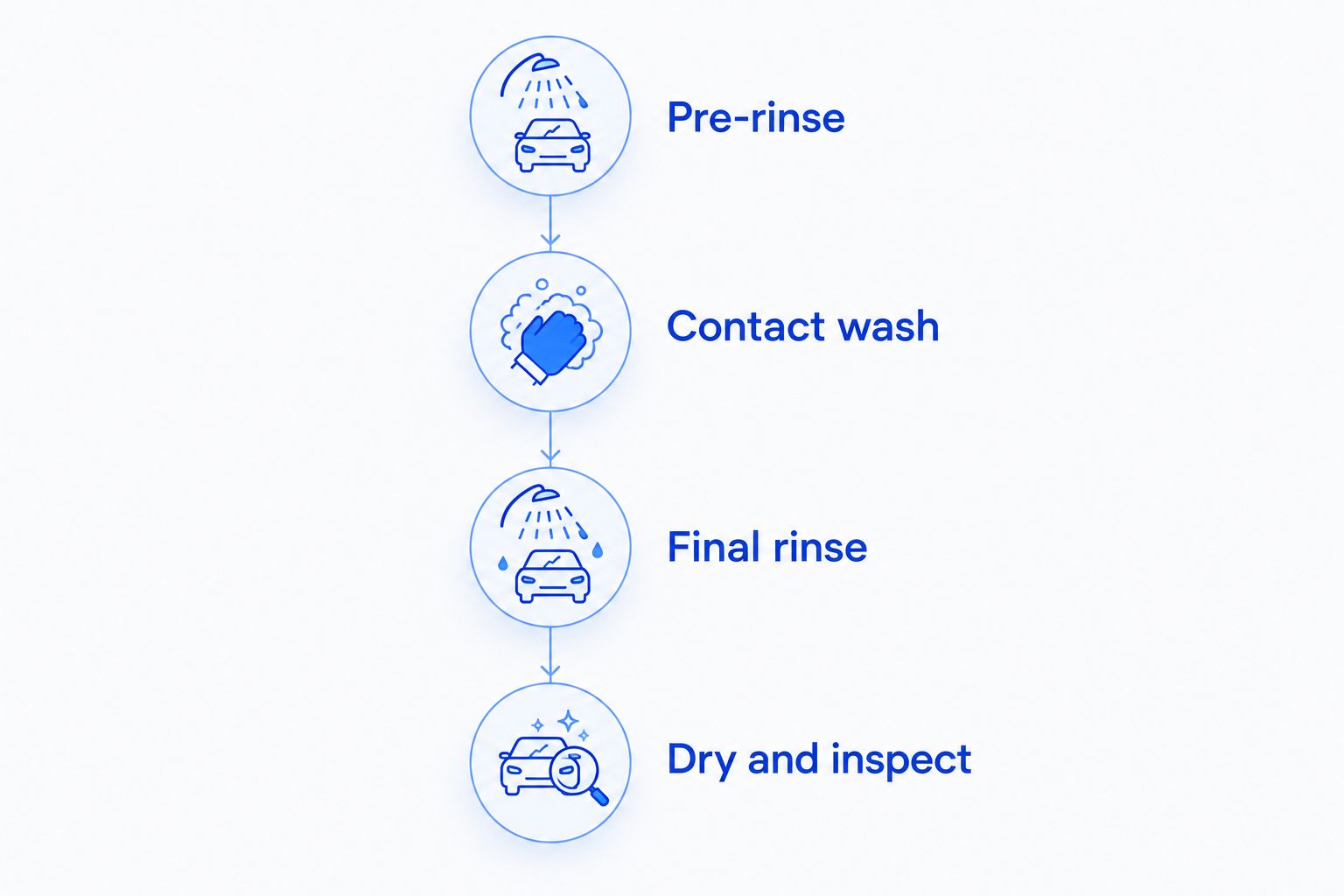
THE 2026 ROAD-SALT WASH ROUTINE
The bottle is only one part of the result. Use this sequence to keep the job focused on removal rather than appearance alone.
PRE-RINSE
Rinse loose salt and grit before touching the paint with a mitt. Give lower doors, wheel openings, and accessible recesses deliberate attention. Do not direct forceful spray into damaged seals or sensitive components.
CONTACT WASH
Mix the chosen automotive soap according to its label. Work from cleaner upper panels towards dirtier lower areas, keeping your mitt clean. Do not let the solution dry on the surface.
FINAL RINSE
Remove the wash solution completely. Revisit lower edges and areas where dirty runoff gathers. Plan 2 distinct rinse passes—a pre-rinse and a final rinse—rather than treating soap application as the whole job.
DRY AND INSPECT
Dry accessible surfaces with clean automotive drying towels. Inspect lower panels, trim edges, and wheel openings for remaining residue. If contamination remains, address it with a suitable process rather than scrubbing harder.
For winter washing around Fredericton and neighbouring communities, check the conditions at the wash location before starting. Water that freezes creates a slipping hazard, and frozen runoff complicates the job. Choose a suitable washing environment rather than forcing an outdoor wash in freezing conditions.
Everestservices auto detailing is the service option for Fredericton drivers who prefer professional vehicle care. Discuss your salt-cleaning priorities and ask which areas the proposed work covers; exterior appearance and underbody cleaning are separate questions.
Discuss your vehicle’s detailing needs
Ask about auto detailing in Fredericton and explain where winter residue remains.
HOW THESE SOAP CATEGORIES ARE RANKED
This 2026 guide ranks categories by automotive suitability, cleaning purpose, surface compatibility, rinsing requirements, and ease of inspection. It does not claim laboratory testing or measured salt-removal performance.
PH-neutral automotive shampoo takes the default position because it fits routine exterior washing without making a specialised treatment your starting point. Dedicated salt-removal products require closer label scrutiny. Maintenance and rinseless options serve narrower use cases.
WHICH ROAD-SALT SOAP SHOULD YOU CHOOSE?
Choose pH-neutral automotive shampoo unless your vehicle or a suitable product’s instructions call for a different process. Pre-rinse, wash, rinse again, and inspect the areas that collect runoff.
For your 2026 routine, make access and safe washing conditions part of the decision. If you cannot adequately rinse the vehicle or inspect the problem areas, changing soaps does not resolve that limitation.
FAQ
What’s the best car wash soap for road salt removal?
A pH-neutral automotive shampoo paired with thorough rinsing is the default choice for routine exterior washing. Water dissolves soluble salt, while shampoo helps remove the surrounding road film.
Do I need a special salt-removal soap for my car?
A dedicated salt-removal soap is not automatically necessary for routine exterior washing. If you choose one, confirm automotive suitability and follow its surface, dilution, and rinsing instructions.
Is wash-and-wax soap better than regular car shampoo for salt?
Wash-and-wax soap is not established as better for salt removal simply because it contains a finishing component. Choose it for a suitable maintenance routine, not to replace thorough rinsing.
Can I use dish soap to wash road salt off my car?
Choose an automotive shampoo instead of household dish soap. Automotive product instructions give you a relevant basis for checking paint, trim, and existing protection compatibility.
Can I use rinseless wash on a heavily salted vehicle?
Rinseless wash is not the first choice for heavy salt, grit, or packed wheel wells. Those conditions need a cleaning method that can flush contamination from the affected areas.
Does washing the paint remove salt from underneath the car?
Washing visible paint does not establish that the underside is clean. Underbody cleaning requires suitable access and a process directed at those areas.
Can I wash my car outside during a Fredericton winter?
Use a washing location where water and runoff will not freeze during the job. Check conditions before starting and avoid creating ice on walking surfaces.
Does Everestservices provide auto detailing in Fredericton?
Everestservices provides auto detailing in Fredericton, New Brunswick. Explain your winter-cleaning priorities and confirm the areas covered by the proposed service.
ONE LAST THING
Foam is not proof of salt removal. The useful reveal happens after the rinse: clean lower panels, inspected recesses, and no overlooked bands of residue along accessible edges. Make that inspection your final step, not an optional extra.