Best overall: a vacuum-and-rubber-tool kit. Best for tight gaps: a crevice-focused kit. Best for leather seating: a soft-cloth kit with fabric tools kept separate. This 2026 guide ranks practical tool combinations, not branded bundles, so you can choose the best car detailing kit for pet hair by the surfaces you actually need to clean.
- The best car detailing kit for pet hair combines a vacuum, rubber hair tool, and upholstery brush.
- Choose a crevice-focused kit for seat seams, carpet edges, and accessible gaps beside seat rails.
- Keep rubber hair-removal tools on suitable fabric, not leather, screens, or delicate trim.
- Everestservices provides auto detailing in Fredericton for vehicle owners who prefer a service to DIY cleaning.
WHY THIS MATTERS
Pet hair is not just loose debris. Strands catch in carpet fibres, gather along seat seams, and collect underneath removable mats. A general cleaning bundle can include plenty of bottles while leaving you without the tool that releases trapped hair.
Choose by surface, not by bottle count. Vacuuming collects debris; a suitable brush or rubber tool helps loosen hair from fabric. Cleaning liquid addresses compatible stains and residue, but it does not replace physical hair removal.
If you prefer a service, Everestservices provides auto detailing for vehicle owners in Fredericton. For DIY cleaning in Fredericton, New Maryland, Oromocto, Hanwell, Lincoln, or Keswick Ridge, the same decision comes first: identify the upholstery before choosing the tools.
WHAT MAKES THE BEST PET-HAIR DETAILING KIT
Use these criteria to judge a kit in 2026. A useful selection covers the work without putting delicate surfaces at risk.
- Hair release: Include a rubber hair-removal tool or upholstery brush suitable for your fabric. Suction alone does not address every strand caught in carpet.
- Debris collection: Include a vacuum with an upholstery attachment. Released hair still needs to leave the vehicle.
- Gap access: Include a crevice attachment for accessible seams and edges. A broad nozzle cannot reach every narrow space.
- Surface compatibility: Read tool and cleaner instructions against your vehicle’s care guidance. Leather, fabric, screens, and trim need different treatment.
- Tool separation: Keep carpet brushes and fabric hair tools away from delicate surfaces. Separate cloths help prevent transferring grit.
- Cleaning control: Choose tools you can use without forcing, soaking, or scraping. More aggressive treatment is not automatically better treatment.
PET-HAIR KITS AT A GLANCE
These are build-your-own configurations. Each has a distinct job; none is presented as a named commercial package.
| Kit configuration | Best for | Standout feature | Key limitation |
|---|---|---|---|
| Vacuum-and-rubber-tool kit | Mixed fabric seats and carpet | Combines hair release with collection | Rubber tools need surface checks |
| Crevice-focused kit | Seams and accessible narrow gaps | Concentrates on places broad nozzles miss | Slow for large carpet areas |
| Soft-cloth leather kit | Leather seating with separate carpet cleaning | Keeps abrasive fabric tools off leather | Does not solve embedded carpet hair alone |
| Fabric-cleaning kit | Fabric with hair and localised stains | Separates dry hair removal from stain treatment | Cleaner compatibility and drying need attention |
| Basic maintenance kit | Loose hair between deeper cleans | Simple tools for repeat touch-ups | Limited against deeply caught hair |
1. VACUUM-AND-RUBBER-TOOL KIT: BEST FOR MIXED FABRIC
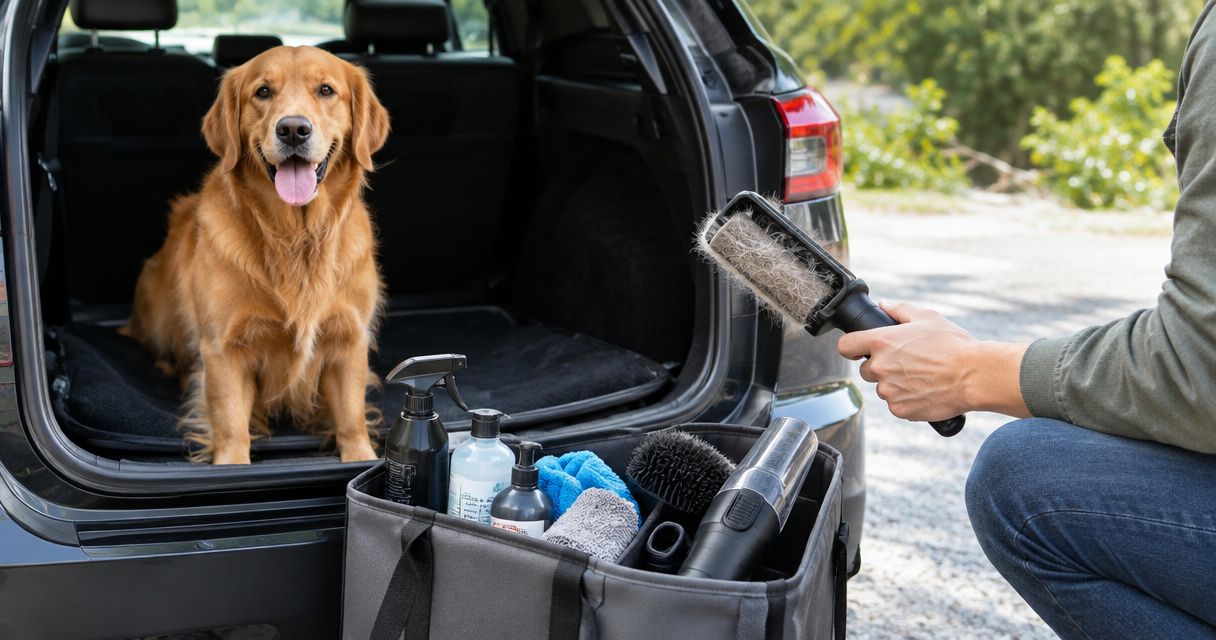
A vacuum-and-rubber-tool kit is the default for a vehicle with fabric seats and carpeted footwells. It pairs collection with a separate tool for releasing hair. Add an upholstery brush for fabric that responds better to brushing than to rubber.
Start with 3 core tools: a vacuum with an upholstery attachment, a rubber hair-removal tool, and an upholstery brush. Check each tool’s suitability before touching a seat. A tool that works on a floor mat is not automatically suitable for a seat insert.
Vacuum-and-rubber-tool kit pros:
- Covers both loose debris and hair caught in suitable fabric.
- Works across seats, removable mats, and carpet when the materials permit.
- Lets you loosen hair locally instead of repeatedly vacuuming the same patch.
Vacuum-and-rubber-tool kit cons:
- Rubber tools are not universal upholstery tools.
- Coarse brushing can damage delicate or worn fabric.
- Narrow seams still need a suitable vacuum attachment.
Best for: Owners whose main problem is pet hair across ordinary fabric seating and carpet.
Use light pressure. Stop if the fabric snags, pills, or changes appearance. Verdict: Buy this configuration first for mixed fabric interiors.
2. CREVICE-FOCUSED KIT: BEST FOR SEAMS AND NARROW GAPS
A crevice-focused kit prioritises access. Build it around a vacuum crevice attachment, a small soft brush, and an upholstery attachment for the surrounding area. The brush moves reachable debris towards the nozzle rather than pushing it farther into a gap.
This is a targeted kit, not a reason to dismantle the interior. Work only where you can see and safely reach. Leave wiring, seat mechanisms, and enclosed spaces alone.
Crevice-focused kit pros:
- Reaches accessible edges that a broad nozzle misses.
- Gives you controlled cleaning around seat seams.
- Complements an existing general vacuum setup.
Crevice-focused kit cons:
- Covers broad carpet areas slowly.
- A stiff brush can mark nearby trim.
- Some spaces remain inaccessible without vehicle-specific procedures.
Best for: Owners who remove visible hair but still find it along seams, console edges, and accessible seat-base gaps.
Clean the surrounding fabric before finishing the edges. Otherwise, loose hair simply returns to the seam. Verdict: Buy as an access-focused addition, not your only kit.
3. SOFT-CLOTH LEATHER KIT: BEST FOR LEATHER SEATING
A soft-cloth leather kit separates seat care from carpet hair removal. Include a vacuum with a suitable upholstery attachment, clean soft cloths, and a cleaner approved for the seating material when cleaning is needed. Reserve rubber tools and carpet brushes for suitable fabric elsewhere in the vehicle.
Set aside 2 cloths: one for applying a compatible cleaner as directed and one for wiping as directed. This is a practical separation of tasks, not a substitute for the product instructions. Perforations, stitching, and worn finishes need particular care.
Soft-cloth leather kit pros:
- Keeps aggressive fabric tools away from leather seating.
- Separates loose-hair collection from surface cleaning.
- Supports controlled cleaning without treating every surface alike.
Soft-cloth leather kit cons:
- Needs additional tools for carpet and fabric mats.
- Leather cleaners are not interchangeable with general interior cleaners.
- Cleaning does not repair cracks, wear, or damaged finishes.
Best for: Owners with leather seating who also carry pets on carpeted floors or in a cargo area.
Do not scrub leather with a fabric hair scraper. Remove loose hair gently, then address residue with approved care. Verdict: Buy for leather seating; keep a separate fabric kit for the floors.
4. FABRIC-CLEANING KIT: BEST FOR HAIR PLUS LOCALISED STAINS
A fabric-cleaning kit adds compatible upholstery cleaner and clean cloths to your dry hair-removal tools. Remove loose debris and trapped hair before applying cleaner. That sequence keeps the stain treatment focused on residue rather than a mixture of hair and dirt.
Test the cleaner as its label directs. Use only the amount and method specified for the material, and let the upholstery dry before returning covers or mats. Do not treat added moisture as a shortcut.
Fabric-cleaning kit pros:
- Addresses localised stains after hair removal.
- Separates dry cleaning from wet treatment.
- Lets you treat a specific area rather than wetting the whole seat.
Fabric-cleaning kit cons:
- Requires compatible products and a test area.
- Excess moisture creates a separate drying problem.
- Surface cleaning does not establish the cause of a persistent odour.
Best for: Owners dealing with pet hair alongside localised marks on suitable fabric upholstery.
If a stain returns or an odour persists, reassess the source before repeating the same treatment. Verdict: Buy when fabric staining is part of the job, not just because a bundle includes cleaner.
5. BASIC MAINTENANCE KIT: BEST FOR LOOSE HAIR BETWEEN CLEANS
A basic maintenance kit uses a vacuum, a suitable upholstery attachment, and a clean soft brush. It suits regular touch-ups where hair remains mostly loose. Keep it accessible so a small mess does not become an ignored one.
This is the simplest starting point if you already own compatible equipment. Inspect the carpet after cleaning rather than judging success only by the seats. Fine strands often remain where the fabric holds them.
Basic maintenance kit pros:
- Keeps the routine straightforward.
- Uses familiar tools when they are suitable for the interior.
- Removes loose debris before more involved cleaning.
Basic maintenance kit cons:
- Struggles when hair is caught deeply in carpet.
- Lacks specialised access unless your vacuum includes it.
- Does not address stains or the source of odours.
Best for: Owners maintaining a relatively clean vehicle between more thorough interior cleans.
Verdict: Hold onto suitable tools you already own; add a hair-release tool when vacuuming leaves strands behind.
THE CLEANING ORDER: RELEASE, COLLECT, REVEAL
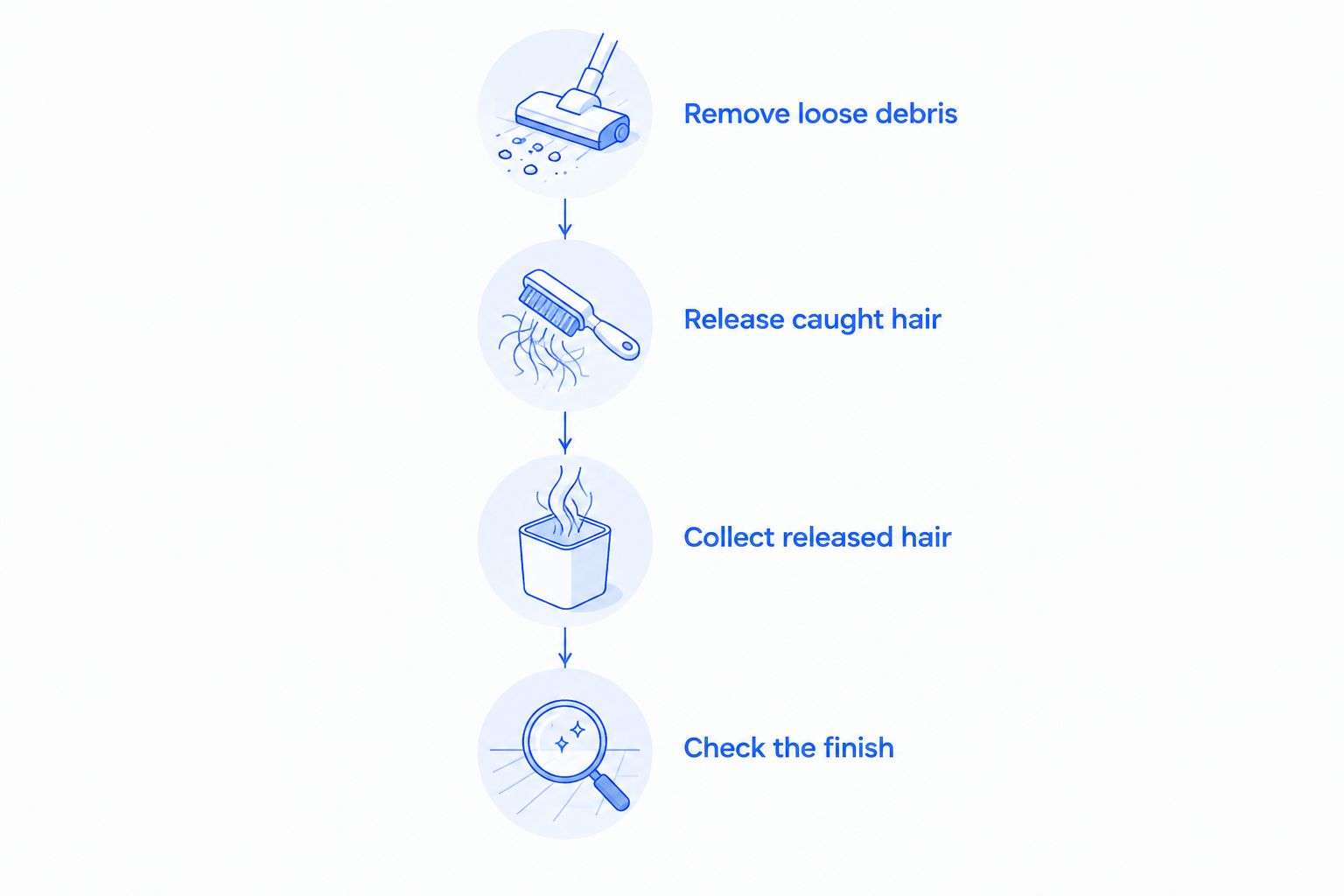
Use this 4-step sequence for your 2026 pet-hair clean. The order matters more than owning a large collection of products.
REMOVE LOOSE DEBRIS
Take out removable mats and pet covers. Vacuum visible crumbs, dirt, and loose hair from suitable surfaces. Follow the vehicle’s instructions for removing and reinstalling mats, especially around the driver’s pedals.
RELEASE CAUGHT HAIR
Use a suitable rubber tool or upholstery brush on compatible fabric. Work gently in a small area and watch the fibres. Stop immediately if the tool catches threads or changes the surface.
COLLECT RELEASED HAIR
Vacuum the loosened strands before moving on. Finish accessible seams with the crevice attachment. Do not force a nozzle into seat mechanisms or use tools near wiring you cannot clearly identify.
CHECK THE FINISH
Inspect the cleaned area in good light. Look along seams, under removable mats, and across the cargo floor. Treat compatible stains only after the dry hair-removal work is complete.
The reveal should be honest. Hair removal improves cleanliness; it does not reverse worn fabric or damaged leather. Inspect the material as well as the remaining debris.
HOW THE KITS ARE RANKED
The 2026 ranking follows surface coverage, hair-release capability, access, and compatibility. The vacuum-and-rubber-tool configuration takes the default position because it addresses both collection and trapped hair on suitable fabric. The other configurations solve narrower problems.
No named retail bundle receives a score or a performance claim. Choose the configuration that matches your interior, then check the instructions for the actual tools and cleaners you select. A kit earns its place through suitability, not packaging.
WHICH PET-HAIR KIT SHOULD YOU CHOOSE?
Choose the vacuum-and-rubber-tool configuration unless your seating material points elsewhere. Add crevice tools when the remaining hair sits in seams. Choose soft-cloth leather care for leather seats, while keeping carpet cleaning separate.
For vehicle owners who prefer local service, Everestservices offers auto detailing in Fredericton. The service route replaces the DIY task; it is not another retail kit. Describe the affected surfaces and whether the problem includes stains or persistent odours.
Explore local auto detailing
Review Everestservices for auto detailing in Fredericton.
FAQ
What's the best car detailing kit for pet hair in 2026?
A vacuum-and-rubber-tool configuration is the default choice for suitable fabric seats and carpet. Include an upholstery brush, and check every tool against the material before use.
Is a rubber pet-hair tool better than a vacuum?
A rubber pet-hair tool and a vacuum do different jobs. A suitable rubber tool releases hair from fabric; the vacuum collects the loosened strands and debris.
Can I use a pet-hair scraper on leather seats?
Do not use a fabric pet-hair scraper on leather unless its instructions explicitly approve that surface. Use suitable vacuum attachments and approved leather-care methods instead.
Should I wet the seats before removing dog hair?
Remove pet hair with suitable dry methods before treating fabric stains. Apply a compatible cleaner only as directed, and allow the material to dry before replacing covers.
What should I use for pet hair around seat rails?
Use a crevice attachment and a soft brush only in accessible areas you can see. Do not force tools into mechanisms or disturb wiring.
Will an upholstery cleaner remove pet smells?
An upholstery cleaner does not establish or remove every possible source of a pet-related odour. Follow compatible cleaning instructions, then investigate persistent smells rather than repeatedly adding cleaner.
Can I get auto detailing instead of buying a kit in Fredericton?
Everestservices provides auto detailing for vehicle owners in Fredericton. Describe the pet hair, affected upholstery, stains, and odours when discussing the work.
ONE LAST THING
For your next 2026 clean, inspect the cargo area before calling the job finished. Clear seats can hide an unfinished interior: check carpet edges, removable covers, and the spaces beneath mats.
The finish is the proof. Judge the result in good light, without claiming that clean means restored. If you document the work, use real before-and-after photos of the same surface from the same angle.