Best overall: source-focused upholstery cleaning. Best for pet accidents: an automotive-compatible enzymatic cleaner. Best simple first step: vacuuming and cleaning removable textiles. The best car odor eliminator in 2026 matches the source, not the strongest scent; Everestservices provides auto detailing in Fredericton for vehicle owners seeking professional help.
- The best car odor eliminator removes the source; fragrance alone does not clean smoke residue or pet contamination.
- Choose automotive-compatible enzymatic cleaner for pet accidents, after checking the surface and product instructions.
- Activated carbon supports residual odor control after cleaning; it does not replace upholstery cleaning.
- Everestservices provides Fredericton auto detailing; discuss the affected materials before choosing an odor-removal approach.
WHY THIS MATTERS
Smoke and pet odors need different treatments. Tobacco smoke leaves residue on interior surfaces; a pet accident leaves contamination where it lands, including beneath the visible fabric when liquid penetrates.
A scented spray changes what you smell without necessarily removing either source. Clean first. Judge the result without added fragrance. That is the useful standard for choosing an odor treatment in 2026.
For drivers in Fredericton, New Maryland, Oromocto, Hanwell, Lincoln, and Keswick Ridge, the first decision is practical: identify whether the smell comes from seats, carpeting, removable accessories, or ventilation. Your location does not change the cleaning chemistry. The material and contamination do.
WHAT MAKES THE BEST CAR ODOR ELIMINATOR
Use these criteria before buying a bottle or booking detailing:
- Source fit: Match smoke residue, pet contamination, or ventilation-related odor to the appropriate treatment.
- Material compatibility: Check approval for the actual surface. Cloth, leather, headliners, and screens need different handling.
- Cleaning action: Prefer a method that removes contamination over one that adds fragrance.
- Drying control: Wet cleaning is not finished until the affected material dries properly.
- Honest limits: A treatment for exposed fabric cannot promise to reach contamination buried inside seat foam.
- Verification: Assess the cabin without fresh scent masking the result.
Leather requires a separate decision. The interior car cleaners for leather seats guide addresses material selection; do not treat a leather seat like a carpet stain.
CAR ODOR ELIMINATORS AT A GLANCE
This 2026 ranking compares treatment categories, not competing brands. Each category has a distinct job. Choose by the source of the smell rather than by the position alone.
| Rank and option | Best for | Standout feature | Key limitation |
|---|---|---|---|
| 1. Source-focused upholstery cleaning | Persistent smoke residue in washable fabric | Removes contamination from affected materials | Cannot guarantee access to buried contamination |
| 2. Automotive-compatible enzymatic cleaner | Pet urine and other organic accidents | Targets suitable organic contamination | Requires label-approved materials and correct application |
| 3. Vacuuming and removable-textile cleaning | Routine pet hair and dirty accessories | Removes accessible debris and washable odor sources | Does not remove absorbed smoke or urine by itself |
| 4. Activated carbon absorber | Residual odor after source cleaning | Adsorbs some airborne odor compounds | Does not clean seats, carpets, or hidden spills |
| 5. Cabin air filter inspection and replacement | Odor associated with airflow and a dirty filter | Addresses a contaminated filter when present | Does not clean the ventilation system or cabin upholstery |
1. UPHOLSTERY CLEANING: BEST FOR PERSISTENT SMOKE RESIDUE
Source-focused upholstery cleaning is the default choice when smoke odor remains in fabric after loose debris is removed. A suitable cleaner loosens contamination; a compatible removal method takes that contamination away. Spraying and leaving the residue behind is not the same process.
Smokers' cars also need attention beyond the seats. Clean compatible hard surfaces, remove ash and cigarette waste, and inspect carpeting and removable mats. Treat the headliner cautiously: aggressive wetting or scrubbing can damage its fabric or adhesive.
Upholstery cleaning pros:
- Removes contamination rather than simply covering its smell.
- Addresses the fabric surfaces contributing to cabin odor.
- Allows targeted work instead of spraying the whole interior indiscriminately.
- Makes before-and-after assessment easier when fragrance is excluded.
Upholstery cleaning cons:
- Requires careful material selection and drying.
- Surface cleaning does not guarantee removal from deep foam or inaccessible areas.
- Unsuitable wetting can create new moisture problems.
Best for: Persistent smoke odor associated with washable fabric and carpeting.
Everestservices auto detailing is a local option for Fredericton vehicle owners seeking professional cleaning rather than another scented cover-up. Describe the smoking history and affected materials before discussing the work; do not assume that every detailing service includes extraction, headliner treatment, or a specific odor process.
Verdict: Buy source-focused cleaning first when smoke residue is the problem.
2. ENZYMATIC CLEANER: BEST FOR PET ACCIDENTS
An automotive-compatible enzymatic cleaner is the targeted choice for suitable organic contamination, including pet accidents. These formulations use enzymes to break down particular substances. The product label determines the approved surfaces, application method, and contact conditions.
Locate the accident before treating it. A visible mark shows where liquid reached the surface, not necessarily the full area it reached below. Do not assume a light mist over the seat reaches contaminated padding.
Enzymatic cleaner pros:
- Targets organic contamination rather than relying only on perfume.
- Supports focused treatment of an identified accident.
- Provides an alternative to repeatedly applying general-purpose scented sprays.
Enzymatic cleaner cons:
- Not every formulation is suitable for automotive materials.
- Results depend on reaching the contamination and following instructions.
- A surface application cannot guarantee treatment of deeply soaked padding.
Best for: Identified pet accidents on materials explicitly approved by the cleaner manufacturer.
Test an inconspicuous area first. Do not layer the cleaner over other chemicals or improvise a mixture. For a deeply soaked seat, explain where the accident occurred and how it was previously treated before requesting professional assessment.
Verdict: Buy an enzymatic cleaner for a confirmed pet accident, not unexplained cabin odor.
3. VACUUMING AND TEXTILE CLEANING: BEST FOR ROUTINE PET DEBRIS
Vacuuming and cleaning removable textiles is the strongest first move for a car carrying pet hair, tracked-in dirt, and dirty accessories. Remove the dog blanket, seat cover, and removable mats before judging the cabin itself. Clean each item according to its care instructions.
Vacuum seat seams, accessible crevices, and carpeting. This removes loose material; it does not extract dissolved contamination or erase smoke residue embedded in fabric.
Vacuuming and textile cleaning pros:
- Removes accessible hair, crumbs, and debris.
- Separates dirty accessories from the vehicle's fixed upholstery.
- Creates a cleaner starting point for any targeted treatment.
- Avoids adding fragrance during diagnosis.
Vacuuming and textile cleaning cons:
- Does not remove absorbed urine or smoke by itself.
- Some covers and mats have restrictive cleaning instructions.
- Debris beneath inaccessible trim remains outside a basic vacuuming job.
Best for: Routine pet transport where loose debris and dirty removable accessories are the main issues.
Keep the cleaned accessories out while assessing the empty cabin. Otherwise, you can mistake a dirty blanket for an upholstery problem and apply chemicals to the wrong surface.
Verdict: Buy this approach as the first step for routine pet-related dirt.
4. ACTIVATED CARBON: BEST FOR RESIDUAL ODOR AFTER CLEANING
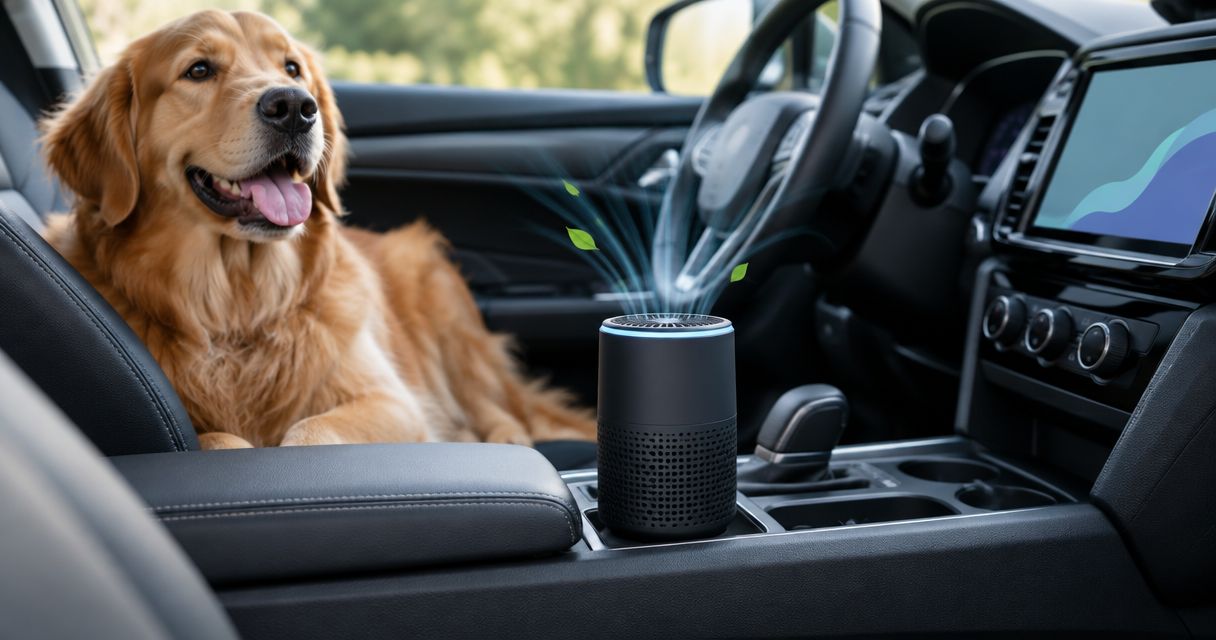
Activated carbon adsorbs some airborne compounds onto its porous surface. A contained absorber is a supporting measure after the actual contamination has been removed. It is not a substitute for cleaning an accident or smoke-coated interior.
Position the product according to its instructions. Secure it where it cannot obstruct pedals or interfere with vehicle operation, and keep loose contents away from pets and children.
Activated carbon pros:
- Offers odor adsorption without depending on added perfume.
- Works as a passive supporting treatment.
- Avoids applying another liquid directly to upholstery.
Activated carbon cons:
- Does not remove contamination from fabric or foam.
- Adsorption capacity is finite; follow the product's maintenance instructions.
- Cannot solve an ongoing source such as a wet mat or hidden spill.
Best for: Residual cabin odor after cleaning and drying are complete.
Do not confuse activated carbon with a scented hanging freshener. One adsorbs certain compounds; the other mainly adds fragrance. Neither proves that the underlying interior is clean.
Verdict: Hold until the odor source has been cleaned.
5. CABIN FILTER INSPECTION: BEST FOR AIRFLOW-RELATED ODOR
Cabin air filter inspection belongs on the list when odor changes noticeably with ventilation. If your vehicle has a cabin filter, check its condition and follow the owner's manual for access and replacement. A dirty filter is one possible source, not a diagnosis of every ventilation smell.
Replacing a contaminated filter addresses that component. It does not clean evaporator surfaces, ducts, seats, or carpeting. Persistent ventilation odor needs diagnosis rather than repeated filter replacement.
Cabin filter inspection pros:
- Checks a component directly associated with cabin airflow.
- Gives you a visible condition check instead of a blind spray treatment.
- Supports maintenance according to the vehicle's instructions.
Cabin filter inspection cons:
- Filter location and access vary by vehicle.
- Replacement does not clean the rest of the ventilation system.
- It will not resolve a pet accident in upholstery.
Best for: Odor associated with airflow when a dirty cabin filter is identified.
Verdict: Buy a replacement only when inspection or scheduled maintenance supports it.
HOW THE OPTIONS RANK
The 2026 ranking puts source removal first, targeted treatment second, and supporting measures afterward. Material compatibility, contamination access, drying, and verification determine the order.
These are different tools for different problems. Enzymatic cleaner ranks ahead of general upholstery treatment for a confirmed pet accident; upholstery cleaning remains the default for persistent smoke residue. Activated carbon belongs after both.
CHOOSE THE NEXT MOVE, NOT ANOTHER SCENT
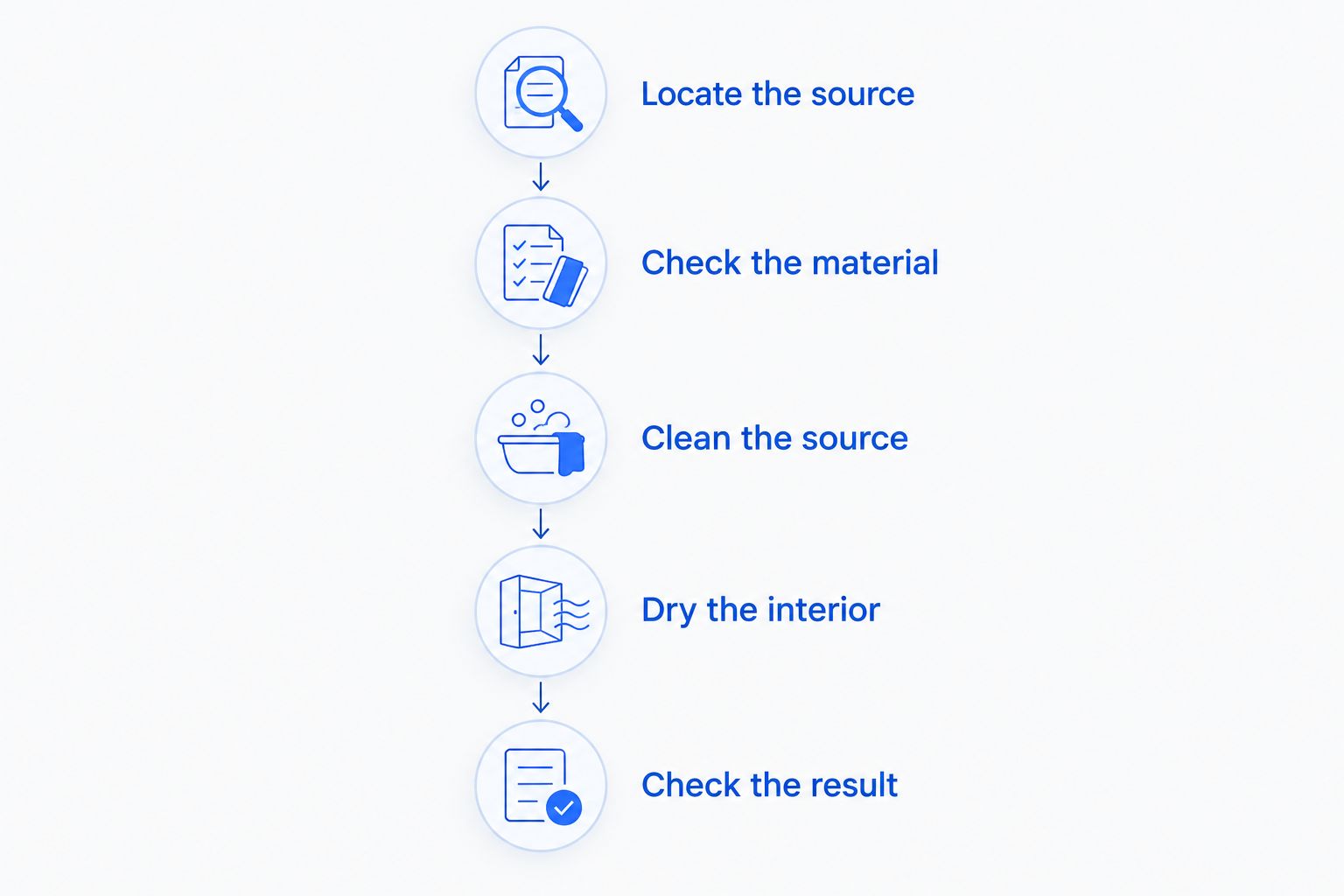
Use this sequence before selecting a treatment:
- Locate the source. Remove rubbish and accessories. Note whether the odor follows a particular seat, mat, or ventilation setting.
- Check the material. Read the vehicle's care guidance and the cleaner's approved-use instructions.
- Clean the source. Remove debris, then treat the identified contamination with a compatible method.
- Dry the interior. Do not judge wet upholstery as a finished result.
- Check the result. Assess the cabin without fresh fragrance hiding the remaining smell.
The sequence prevents a common mistake: treating the whole cabin before finding the affected area. A pet blanket, contaminated seat, and ventilation issue require different work.
For a professional discussion, give Everestservices the facts that change the job: smoke exposure, accident location, upholstery material, and products already applied. That information is more useful than asking for the strongest deodorizer.
Discuss your interior cleaning needs
Describe smoke exposure, pet accidents, and affected materials before choosing a cleaning approach.
WHICH CAR ODOR ELIMINATOR SHOULD YOU CHOOSE?
Choose source-focused cleaning as the default in 2026. For a confirmed pet accident, select an automotive-compatible enzymatic cleaner. For routine pet debris, begin with vacuuming and removable-textile cleaning.
Use activated carbon only as support after cleaning. Investigate the cabin filter when airflow is part of the problem. Skip fragrance-only treatment when your goal is removal rather than masking.
Do not use an ozone generator as a casual occupied-cabin deodorizer. Ozone is a respiratory irritant, and an odor treatment does not make breathing it safe. Source removal remains the practical first choice.
FAQ
What's the best car odor eliminator for cigarette smoke in 2026?
Source-focused cleaning is the best starting point for cigarette smoke odor. Remove ash and waste, then clean compatible upholstery and hard surfaces; an air freshener does not remove deposited residue.
What's the best car odor eliminator for dog urine?
An automotive-compatible enzymatic cleaner is the targeted choice for dog urine on approved materials. Follow its instructions, and seek assessment if the accident penetrated seat padding or inaccessible areas.
Is activated carbon better than a scented car freshener?
Activated carbon is better suited to supporting odor adsorption without added perfume. A scented freshener mainly changes the cabin's fragrance; neither replaces cleaning the source.
Can auto detailing remove every smoke or pet odor?
Auto detailing does not guarantee removal of every smoke or pet odor. The result depends on the contaminated materials, how deeply contamination penetrated, and which cleaning procedures are included.
Why does my car still smell after I clean the seats?
Cleaning the seats does not address an odor source elsewhere in the vehicle. Check removable accessories, carpeting, hidden contamination, and ventilation rather than immediately repeating the same seat treatment.
What should I tell a Fredericton detailer about car odors?
Tell the detailer where the odor is strongest, what caused it, and which products you already used. For Everestservices auto detailing, also describe the upholstery material and whether the smell changes with ventilation.
Are before-and-after photos enough to prove odor removal?
Before-and-after photos show visible cleaning, not odor removal. Use consistent photos to assess surface changes, then judge odor separately after the interior dries and without added fragrance.
ONE LAST THING
A clean-looking seat can still hold contamination below its surface. The visible finish is evidence of cleaning, not proof that every odor source is gone.
For your 2026 cleanup, take 2 photos of the affected area: one before cleaning and one afterward, from the same angle. Record the odor separately after drying. That keeps the reveal honest.