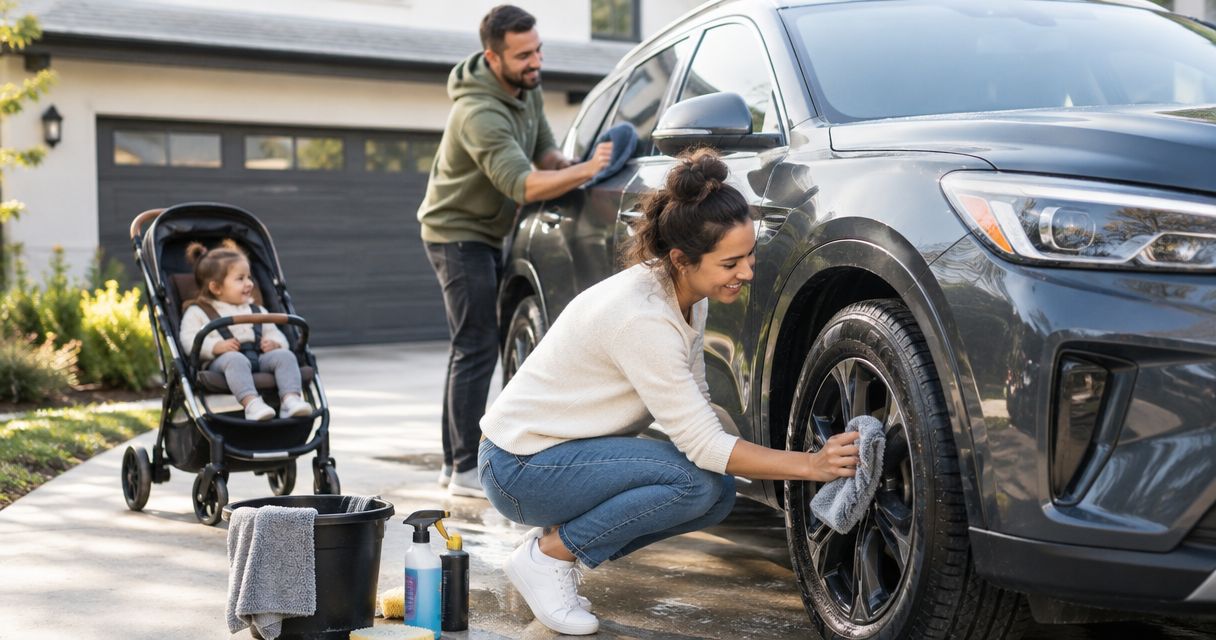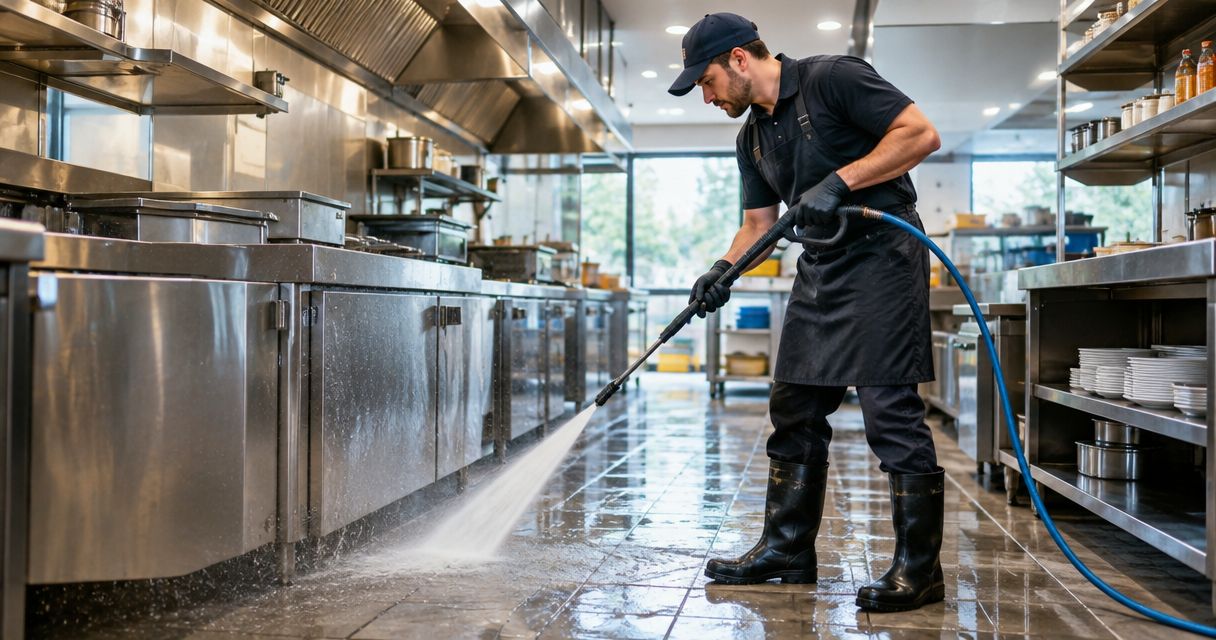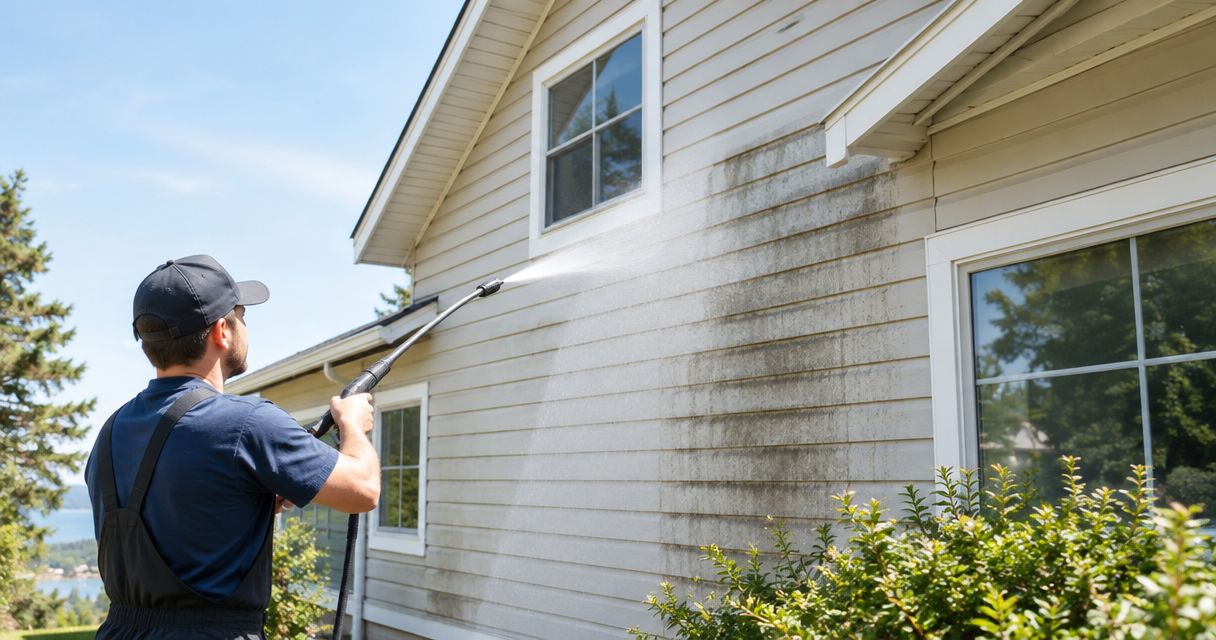
Best overall: a surface-matched professional wash. Best for routine siding dirt: a compatible mild-detergent wash. Best for algae staining: an exterior cleaner labelled for the surface. This 2026 guide compares the best exterior house wash solutions for New Brunswick homes, including when to consider Everestservices for exterior pressure washing.
- The best exterior house wash solutions match the siding material, stain and condition—not the strongest pressure setting.
- Everestservices provides exterior pressure washing for Fredericton homeowners; discuss the surface and scope before booking.
- Choose compatible mild detergent for routine dirt and a surface-labelled exterior cleaner for algae staining.
- Stop washing when you find loose finishes, open joints or water entering the building.
WHY THIS MATTERS
A clean exterior should reveal the finish, not remove it. Pressure, chemistry and application technique all affect the result. Choosing a cleaner before identifying the surface reverses the decision.
For homeowners in Fredericton, New Maryland, Oromocto, Hanwell, Lincoln and Keswick Ridge, the useful starting point is the same: inspect your own house. Vinyl, painted wood and brick need different treatment. A shaded wall with green staining also presents a different job from a dusty entrance.
For your 2026 house wash, choose the method that addresses the stain without damaging the surface. More force is not a substitute for a better diagnosis.
WHAT MAKES THE BEST EXTERIOR HOUSE WASH SOLUTIONS
Use these criteria before choosing a service, cleaner or washing method:
- Surface compatibility: The cleaner label and siding manufacturer's guidance must permit the treatment.
- Stain match: Separate ordinary dirt from algae, rust, mineral deposits and failing paint.
- Finish condition: Check for chalking, peeling, cracks and loose joints before adding water or chemicals.
- Application control: You need control over spray direction, coverage, rinsing and runoff.
- Safe access: A method is unsuitable if reaching the wall requires an unstable working position.
- Clear scope: Know which walls, trims and adjacent surfaces the job includes—and which it excludes.
A suitable cleaner can still produce a poor result when applied incorrectly. Read the instructions before opening the container. Never mix cleaning products, and follow the stated protective-equipment requirements.
HOUSE WASH OPTIONS AT A GLANCE
These are ranked treatment routes, not interchangeable products. No single route suits every exterior.
| Rank and option | Best for | Standout feature | Key limitation |
|---|---|---|---|
| 1. Surface-matched professional wash | Complex jobs or difficult access | Assessment and application can be handled together | Confirm the provider's method and scope |
| 2. Compatible mild-detergent wash | Routine dirt on intact washable siding | A targeted starting point for ordinary grime | Does not address every stain |
| 3. Surface-labelled algae cleaner | Green growth-related staining | Cleaner selected for the staining problem | Compatibility and runoff precautions matter |
| 4. Substrate-specific masonry cleaner | Staining on sound, unpainted masonry | Treatment selected for both masonry and stain | Wrong chemistry can damage the surface |
| 5. Low-pressure water rinse | Loose dust on accessible, intact surfaces | No added cleaning chemical | Limited effect on attached grime or staining |
1. PROFESSIONAL WASH: BEST FOR COMPLEX EXTERIORS
A surface-matched professional wash starts with identifying the material and its condition. You then agree on a treatment, access plan and cleaning scope rather than asking someone to wash every surface the same way.
Everestservices is a local option for Fredericton homeowners seeking exterior pressure washing. Ask how the proposed method fits your siding before committing. The service category alone does not establish which cleaners, equipment settings or access methods a particular job requires.
Professional wash pros:
- Gives you a route for discussing mixed surfaces before work begins.
- Lets you address difficult access as part of the job assessment.
- Creates an opportunity to define exclusions around damaged finishes.
- Allows you to request consistent before-and-after documentation.
Professional wash cons:
- Provider methods differ; confirm the treatment rather than assuming it.
- Washing cannot repair deteriorated siding, failed paint or leaking joints.
- An unclear scope makes the finished result harder to assess.
Best for: Homeowners with mixed exterior materials, difficult access or uncertainty about the stain.
For a 2026 booking, send photos of the full wall and close-ups of the problem area. Describe any known leaks, previous coatings or loose sections. Give the provider information that changes the method—not just the instruction to make everything look new.
Verdict: Buy professional help when assessment or access is the main challenge.
2. MILD-DETERGENT WASH: BEST FOR ROUTINE SIDING DIRT
A compatible mild-detergent wash targets ordinary surface dirt on intact, washable siding. The important word is compatible: a general household cleaner is not automatically suitable for every exterior finish.
Follow the siding manufacturer's cleaning guidance and the cleaner's application instructions. Use only the permitted tools and rinsing method. A small test area checks whether the treatment affects appearance before you commit to a full wall.
Mild-detergent wash pros:
- Addresses routine grime without starting with aggressive chemistry.
- Lets you work on a defined, accessible section.
- Supports a simple test-and-inspect approach.
Mild-detergent wash cons:
- Persistent biological or mineral staining needs a different assessment.
- Excessive scrubbing can damage vulnerable finishes.
- Residue remains a concern if rinsing is incomplete.
Best for: Ordinary dirt on intact siding whose care instructions permit detergent cleaning.
Do not treat extra detergent as extra cleaning power. Use the dilution and application directions on the chosen product. If the test section stays stained after correct use, identify the stain before changing products.
Verdict: Buy a compatible mild detergent for routine dirt; skip it as a universal stain remover.
3. ALGAE CLEANER: BEST FOR GREEN EXTERIOR STAINING
A surface-labelled algae cleaner is intended for the growth-related staining named on its label. Select it by both the problem and the substrate. A product suitable for one exterior material is not automatically suitable for another.
Green discoloration alone does not identify every organism or establish the underlying cause. If you cannot distinguish surface growth from a coating problem, get an assessment before treatment. Cleaning the colour away also does not correct a drainage or moisture problem.
Algae cleaner pros:
- Targets a staining category that plain water does not reliably remove.
- Provides product-specific application and handling instructions.
- Lets you check suitability for the actual exterior material.
Algae cleaner cons:
- Nearby plants and adjacent finishes require the precautions stated on the label.
- The cleaner does not fix recurring moisture exposure.
- Incorrect dilution or application can damage surfaces.
Best for: Growth-related staining on a surface expressly permitted by the cleaner label.
For your 2026 treatment plan, photograph the affected wall before cleaning. Check whether downspouts, splashing or vegetation keep the area damp. Address the source separately from the visible stain.
Verdict: Buy only a surface-compatible algae cleaner; skip unlabelled chemical combinations.
4. MASONRY CLEANER: BEST FOR SPECIFIC BRICK OR STONE STAINS
A substrate-specific masonry cleaner addresses a named stain on compatible brick, stone or concrete. Select the treatment after inspecting both the masonry units and the joints. Painted masonry requires its own finish-compatible approach.
White deposits, rust marks and biological staining are different problems. Do not assume they need the same cleaner. Acidic treatments are not a general-purpose choice, particularly where the material's compatibility is unknown.
Masonry cleaner pros:
- Matches the cleaner to a defined stain rather than treating all discoloration alike.
- Accounts for the masonry material as well as the visible mark.
- Supports a contained test before broader application.
Masonry cleaner cons:
- Damaged mortar or unstable surfaces need attention before washing.
- Incorrect chemistry can etch or discolour susceptible materials.
- A cleaner approved for concrete is not automatically approved for natural stone.
Best for: A diagnosed stain on sound, unpainted masonry with confirmed product compatibility.
If mortar crumbles during inspection, pause the cleaning plan. If the stone type is unknown, identify it first. The stain does not justify risking the substrate beneath it.
Verdict: Buy a masonry treatment only after matching the stain and material; hold when either is uncertain.
5. WATER RINSE: BEST FOR LOOSE SURFACE DUST
A low-pressure water rinse removes loose material without adding a cleaning chemical. It suits a limited task: accessible, intact surfaces with dust or debris that releases easily.
Keep water out of openings and follow the surface manufacturer's washing guidance. A rinse is not permission to direct water into siding laps, vents, fixtures or damaged seals.
Water rinse pros:
- Adds no detergent to the cleaning process.
- Provides a simple option for loose dust.
- Lets you inspect the exposed surface before deciding on further treatment.
Water rinse cons:
- Does not reliably remove attached biological staining.
- Cannot resolve embedded marks or damaged finishes.
- Poor spray direction can still send water into vulnerable areas.
Best for: Light dust on reachable surfaces in sound condition.
Stop if the remaining mark is attached staining rather than loose dirt. Repeated rinsing is not a diagnosis. Move to a compatible treatment only after identifying what remains.
Verdict: Hold this option for light maintenance; skip it as a complete treatment for persistent staining.
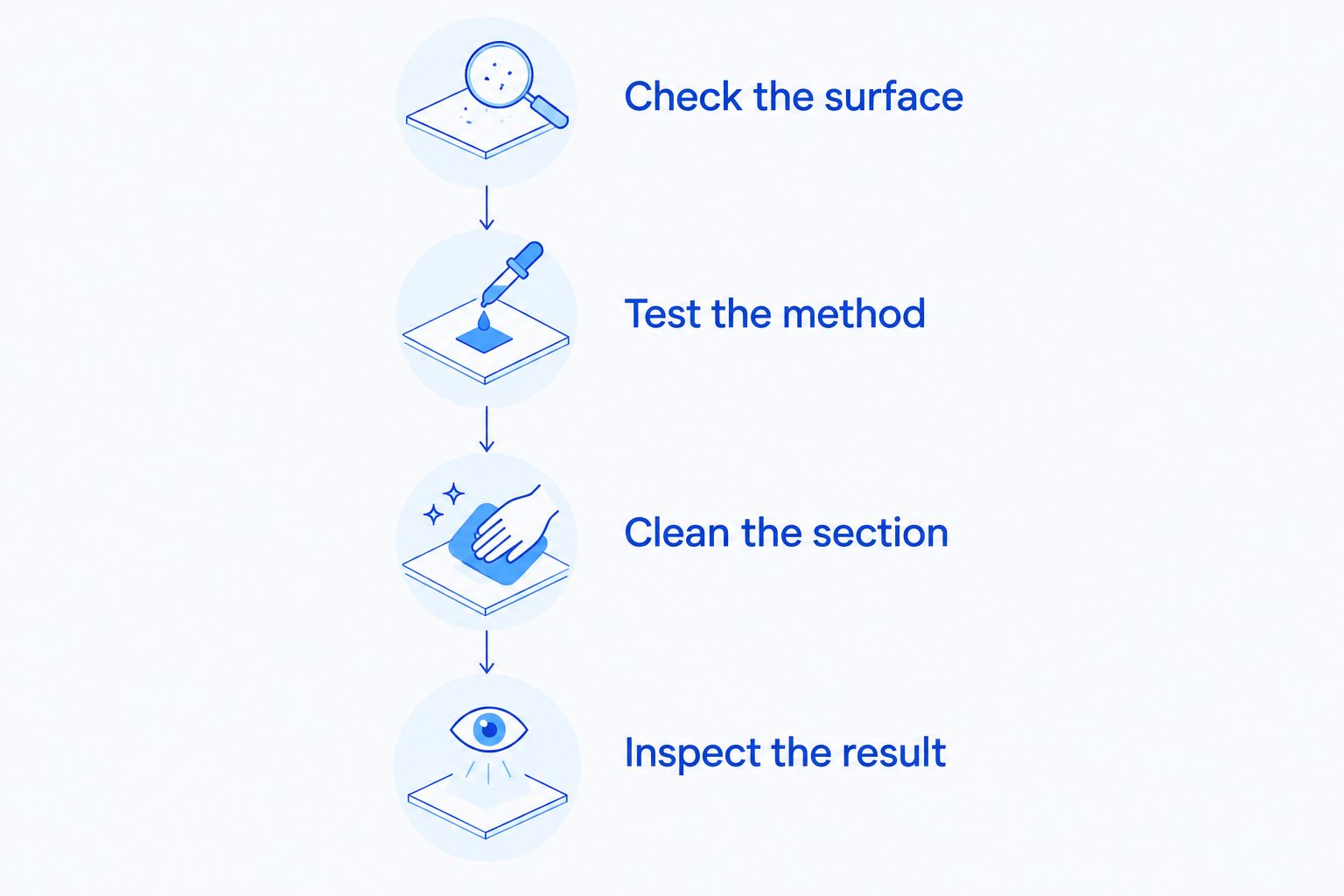
BEFORE YOU WASH: CHECK, TEST, CLEAN, INSPECT
Use this sequence for any 2026 exterior cleaning plan. It keeps the decision focused on the surface, not the equipment.
CHECK THE SURFACE
Identify the siding or masonry, locate openings and inspect visible damage. Take 3 photos: the whole elevation, the stain close-up and any vulnerable joint or finish. These are useful reference views, not a substitute for inspection.
TEST THE METHOD
Start with 1 test patch in an inconspicuous location, as permitted by the care instructions. Apply and rinse according to the cleaner label. Let the area dry before judging colour or finish changes.
CLEAN THE SECTION
Use the approved method only where the test supports it. Follow the label's conditions and protect adjacent materials as directed. Stop if the finish loosens, the surface changes unexpectedly or water enters the building.
INSPECT THE RESULT
Check the dry section from 2 viewing angles: straight on for remaining stains and obliquely for streaks or finish changes. Compare like with like. Wet siding can look darker and conceal an uneven result.
Real before-and-after photos should show the same wall, similar framing and comparable lighting. Ask for the dry result, not just the freshly rinsed surface. That is where the finish becomes the proof.
Discuss Your Exterior Wash
Ask Everestservices about your exterior surface, visible staining and the scope of the job.
HOW THESE OPTIONS ARE RANKED
This 2026 ranking prioritizes surface compatibility, stain match, finish condition, application control, safe access and clear scope. Professional assessment leads for complex jobs; targeted DIY methods follow for narrower tasks.
The order does not mean a professional wash is necessary for loose dust. It means uncertainty deserves attention before treatment. Each option wins a distinct use case.
WHICH EXTERIOR HOUSE WASH SOLUTION SHOULD YOU CHOOSE?
Choose by surface and stain first. Choose equipment second. For routine dirt on intact siding, start with its approved cleaning instructions. For growth-related staining or masonry marks, select a treatment expressly suited to that problem and material.
If you are unsure about access, condition or compatibility, discuss exterior pressure washing with Everestservices before attempting the job. Ask what should be cleaned, what should be left alone and what needs repair first.
For equipment selection, read the guide to pressure washers for house washing. A machine comparison supports the cleaning plan; it does not replace one.
FAQ
What's the best exterior house wash solution for a New Brunswick home?
The best exterior house wash solution matches the material, stain and finish condition. Use a compatible mild-detergent wash for routine dirt, a surface-labelled treatment for specific staining, or professional assessment when the job is uncertain.
Is pressure washing better than soft washing for house siding?
Neither method is automatically better for every siding material. Follow the siding manufacturer's guidance and confirm the proposed cleaner, application pressure and rinsing method before work begins.
Can I use the same cleaner on vinyl siding and brick?
Use the same cleaner only if its label permits both materials and the application suits their condition. Brick joints and vinyl finishes present different concerns, so check each surface separately.
What removes green staining from exterior siding?
A compatible exterior cleaner labelled for algae or the identified growth-related staining is the appropriate treatment route. Confirm the diagnosis and follow the label's precautions for plants, adjacent finishes and runoff.
Should I wash siding that has peeling paint or loose joints?
Pause washing when paint is peeling or joints are loose. Assess the damage first because cleaning does not repair the finish or restore a watertight joint.
Can I clean my house exterior with water alone?
Water alone suits loose dust on accessible, intact surfaces. Attached grime and persistent staining require identification and a compatible treatment rather than repeated rinsing.
What should I ask before booking an exterior house wash?
Ask which surfaces are included, how the method matches your siding and which damaged areas will be excluded. For a 2026 booking, provide photos and disclose known leaks, loose finishes or previous coatings.
Does Everestservices offer exterior pressure washing in Fredericton?
Everestservices provides exterior pressure washing services for homeowners in Fredericton, New Brunswick. Discuss your property's materials, staining and access requirements to establish the appropriate job scope.
ONE LAST THING
Judge the transformation after the surface dries. A wet wall is not the finished result. Compare the same area under similar lighting, then check the joints and nearby surfaces as carefully as the cleaned face.
Clarity returns when the dirt is removed and the original finish remains intact. That is the result to ask for—not simply a stronger wash.