Best overall: a non-acid wheel cleaner approved for your wheel finish. Best for dirty rubber: a dedicated tire cleaner. Best for routine maintenance: car wash shampoo. This 2026 guide matches the best wheel and tire cleaner for winter grime to the surface and contamination—not the strongest formula on the shelf.
- The best wheel and tire cleaner for winter grime matches your wheel finish and the contamination.
- Choose a compatible non-acid wheel cleaner for wheel cleaning; use a dedicated tire cleaner on rubber.
- Use an iron fallout remover for ferrous contamination, not as a substitute for tire cleaning.
- Everestservices offers auto detailing for Fredericton drivers seeking help with winter grime.
WHY THIS MATTERS
Winter grime is not one problem. Loose road grit, dried salt residue, oily road film, and brake dust call for different cleaning actions. Your wheel finish also sets the limits.
Everestservices auto detailing is for Fredericton vehicle owners who want professional help with winter grime. You can explore Everestservices if you prefer a service rather than building a cleaning kit. For DIY cleaning, start by identifying what you are cleaning and what is stuck to it.
The same decision applies in New Maryland, Oromocto, Hanwell, Lincoln, and Keswick Ridge. Choose a place where runoff is permitted, footing is secure, and rinse water will not freeze. A cleaner is only part of the job.
WHAT MAKES THE BEST WINTER WHEEL CLEANER
For your 2026 cleaning kit, use these criteria before choosing a formula:
- Finish compatibility: The label must explicitly permit use on your wheel material and finish. Painted, polished, anodized, and coated surfaces are not interchangeable.
- Contamination match: Separate loose dirt and salt residue from road film and embedded ferrous particles. Do not escalate chemistry before removing loose material.
- Surface-specific instructions: A wheel cleaner is not automatically a tire cleaner. A combined product must include directions for both surfaces.
- Controlled application: You need clear instructions for dilution, dwell time, agitation, and rinsing. Follow the label rather than improvising.
- Practical maintenance: Pick something you can use correctly with your available water, brushes, and working conditions. A complicated process is not automatically a better clean.
Keep 2 separate brushes: one for wheel surfaces and one for tire sidewalls. Separation helps you avoid carrying tire grime onto the wheel face. Select brush materials appropriate for the finish; stiffness alone is not a measure of usefulness.
WINTER CLEANERS AT A GLANCE
These are cleaner categories, not interchangeable formulas. Every recommendation depends on the individual product's directions and your vehicle manufacturer's care guidance.
| Ranked option | Best for | Standout feature | Key limitation |
|---|---|---|---|
| Non-acid wheel cleaner | General wheel cleaning | Wheel-focused cleaning without an acid formula | Non-acid does not mean safe for every finish |
| Dedicated tire cleaner | Dirty tire sidewalls | Instructions specifically for rubber cleaning | Does not replace a compatible wheel cleaner |
| Iron fallout remover | Ferrous contamination on wheels | Targets iron-containing particles | Not a general solution for every winter deposit |
| Car wash shampoo | Frequent maintenance cleaning | Fits into a regular exterior wash | Not the first choice for stubborn embedded contamination |
| Combined wheel and tire cleaner | A smaller cleaning kit | Covers both surfaces when explicitly approved | One formula still requires surface-specific handling |
1. NON-ACID WHEEL CLEANER: BEST FOR GENERAL WHEEL CLEANING
A compatible non-acid wheel cleaner is the default starting point when rinsing alone leaves the wheel dirty. It addresses wheel cleaning without choosing an acid-based formula. That description does not establish its pH, strength, or compatibility.
For a 2026 winter routine, read the actual finish exclusions first. If your wheel finish is unknown, confirm it before applying a cleaner. The word wheel on the bottle is not permission to use it everywhere.
Non-acid wheel cleaner pros:
- Gives you a wheel-specific cleaning option.
- Avoids selecting an acid formula for routine work.
- Can fit a repeatable wash routine when the label permits regular use.
Non-acid wheel cleaner cons:
- Formulas differ; the category name does not guarantee compatibility.
- A general wheel cleaner does not necessarily address bonded ferrous particles.
- Wheel approval does not automatically include tire sidewalls.
Best for: Drivers who need a dedicated wheel cleaner after loose winter deposits have been rinsed away.
Apply only under the label's temperature and surface conditions. Use compatible agitation where instructed, and rinse thoroughly. Keep the cleaner away from excluded materials rather than relying on a quick rinse to correct an unsuitable application.
Verdict: Buy a non-acid wheel cleaner only after confirming your wheel finish is approved.
2. DEDICATED TIRE CLEANER: BEST FOR DIRTY SIDEWALLS
A dedicated tire cleaner puts the rubber sidewall at the centre of the instructions. It is the cleaner category to consider when dirt or old dressing remains after washing. Use it on the surfaces the manufacturer specifies—not automatically on the wheel beside them.
The goal is a clean sidewall, not an artificially glossy one. Dressing is a separate finishing step. Do not confuse shine with removal of winter grime.
Dedicated tire cleaner pros:
- Provides tire-specific application guidance.
- Lets you clean rubber separately from a delicate wheel finish.
- Keeps the cleaning decision separate from the choice of dressing.
Dedicated tire cleaner cons:
- Adds another product and application step.
- Overspray still needs control around adjacent finishes.
- Cleaning does not repair cuts, cracking, or other tire damage.
Best for: Drivers whose wheels rinse clean but whose tire sidewalls still look dirty.
Use the tire brush on the sidewall and follow the cleaner's directions for agitation. Never use a freshly dressed appearance as evidence that the rubber is clean. Inspect the surface before adding any finishing product.
Verdict: Buy a dedicated tire cleaner when rubber—not the wheel face—is the remaining problem.
3. IRON FALLOUT REMOVER: BEST FOR FERROUS CONTAMINATION
An iron fallout remover targets iron-containing contamination, including ferrous particles associated with brake dust. Choose a formula specifically approved for your wheel finish. It is a targeted treatment, not a reason to skip the initial rinse and wash.
Some iron-removal formulas change colour during use. Follow that product's instructions; colour alone is not a universal measure of cleaning progress or a signal to extend dwell time.
Iron fallout remover pros:
- Targets a particular contamination type.
- Provides an alternative to treating every remaining mark as ordinary dirt.
- Supports a staged process after general cleaning.
Iron fallout remover cons:
- Does not replace tire cleaning or removal of loose grit.
- Requires its own compatibility and application checks.
- Does not establish whether a mark is contamination, corrosion, or finish damage.
Best for: Wheels with remaining ferrous contamination after an appropriate general wash.
Do not treat every dark spot as brake dust. If a mark remains and you cannot identify it, stop escalating products. Inspect the finish and seek qualified advice rather than repeatedly applying different chemicals.
For 2026, the useful rule stays simple: target the deposit, not the colour of the wheel.
Verdict: Hold unless ferrous contamination is the problem; then choose a finish-approved formula.
4. CAR WASH SHAMPOO: BEST FOR FREQUENT MAINTENANCE
Car wash shampoo belongs in a maintenance routine when loose dirt and ordinary surface soil are the main concerns. Use a product whose directions permit the intended surfaces. Rinsing removes loose material; shampoo and suitable agitation address the remaining washable soil.
This is the simplest starting point for wheels that receive regular attention. It also helps you see whether specialist treatment is actually necessary.
Car wash shampoo pros:
- Fits into an existing exterior wash routine.
- Keeps the initial cleaning stage straightforward.
- Lets you assess remaining contamination before adding specialist chemistry.
Car wash shampoo cons:
- Is not a dedicated treatment for bonded ferrous particles.
- Does not necessarily remove stubborn tire dressing residue.
- Still requires suitable tools and thorough rinsing.
Best for: Regular maintenance before winter deposits become a more involved cleaning job.
Keep wheel tools separate from paint-washing tools. A brush or mitt used around gritty wheel areas should not immediately move onto painted bodywork. Clean the tools according to their care instructions before storing them.
Verdict: Buy for maintenance; skip it as your only answer to stubborn wheel contamination.
5. COMBINED WHEEL AND TIRE CLEANER: BEST FOR A SMALLER KIT
A combined wheel and tire cleaner is useful when its label explicitly approves both your wheel finish and tire sidewalls. It reduces the number of cleaner categories in your kit. It does not remove the need to treat the surfaces separately.
Read both sets of instructions. A formula approved for a tire sidewall can still carry restrictions for polished metal, damaged coatings, or other wheel finishes.
Combined wheel and tire cleaner pros:
- Keeps the cleaning kit simpler.
- Covers wheels and sidewalls when both uses are explicitly approved.
- Makes sense for a routine built around one compatible formula.
Combined wheel and tire cleaner cons:
- Both surfaces must fall within the product's permissions.
- Separate brushes remain necessary.
- Specialist contamination can still require a different treatment.
Best for: Drivers who want fewer products and have confirmed compatibility for both surfaces.
A combined cleaner is a convenience choice, not proof of stronger performance. If either surface is excluded, choose separate compatible products instead. Do not trade finish safety for a smaller kit.
Verdict: Buy when both surfaces are approved; skip when the compatibility instructions are unclear.
CLEAN IN THE RIGHT ORDER
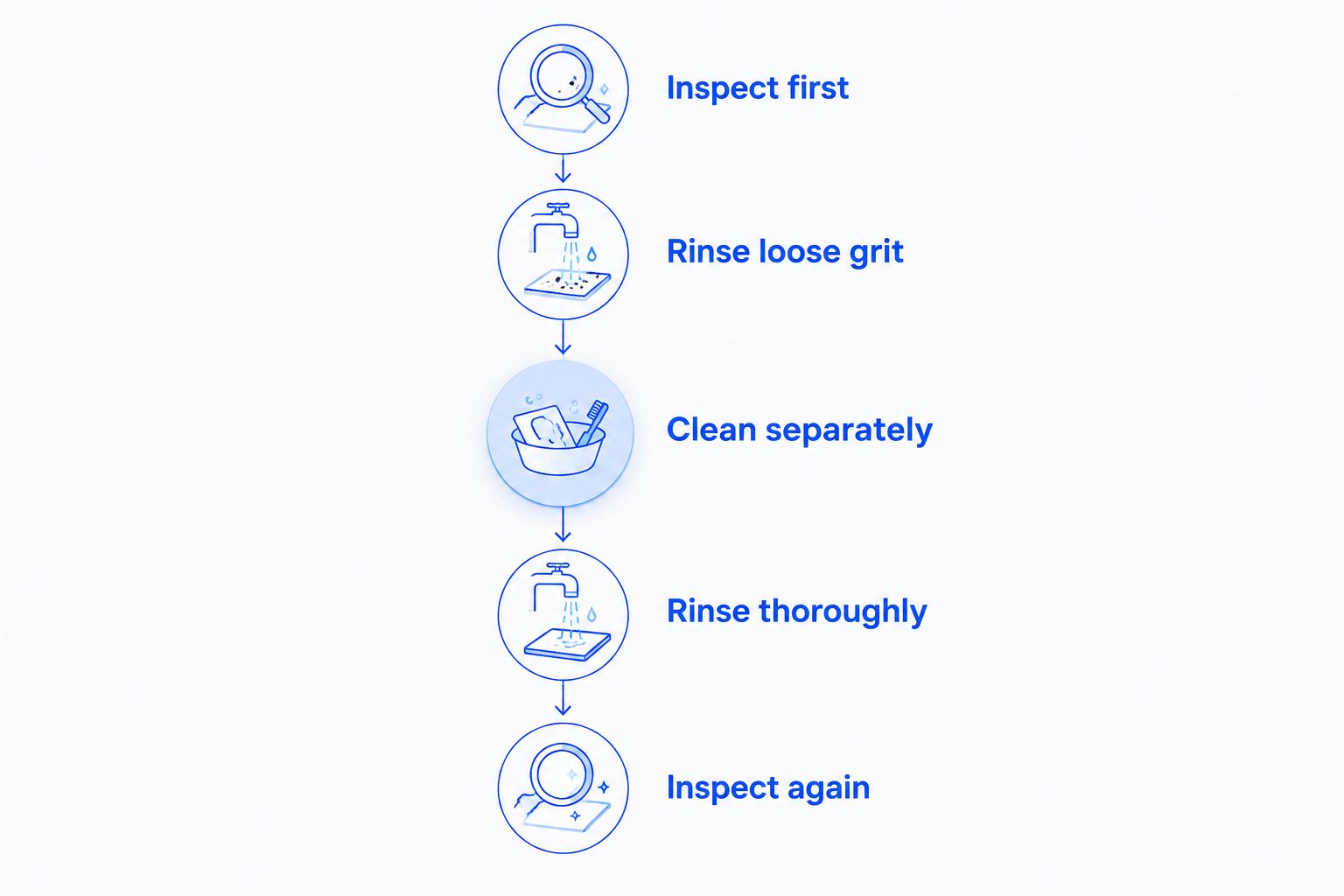
Work on 1 wheel at a time. That is a handling recommendation, not a dwell-time instruction: the cleaner's label controls how long it stays on the surface. Do not begin if you cannot complete the rinse safely.
Inspect first
Identify the wheel finish and inspect for visible damage. Check the tire sidewall separately. Unknown material or damaged coating is a reason to confirm the correct approach before cleaning.
Rinse loose grit
Remove loose road material before brushing. Direct the rinse around the wheel face and accessible recesses without using concentrated pressure as a substitute for suitable cleaning. Follow vehicle care guidance for washing equipment.
Clean separately
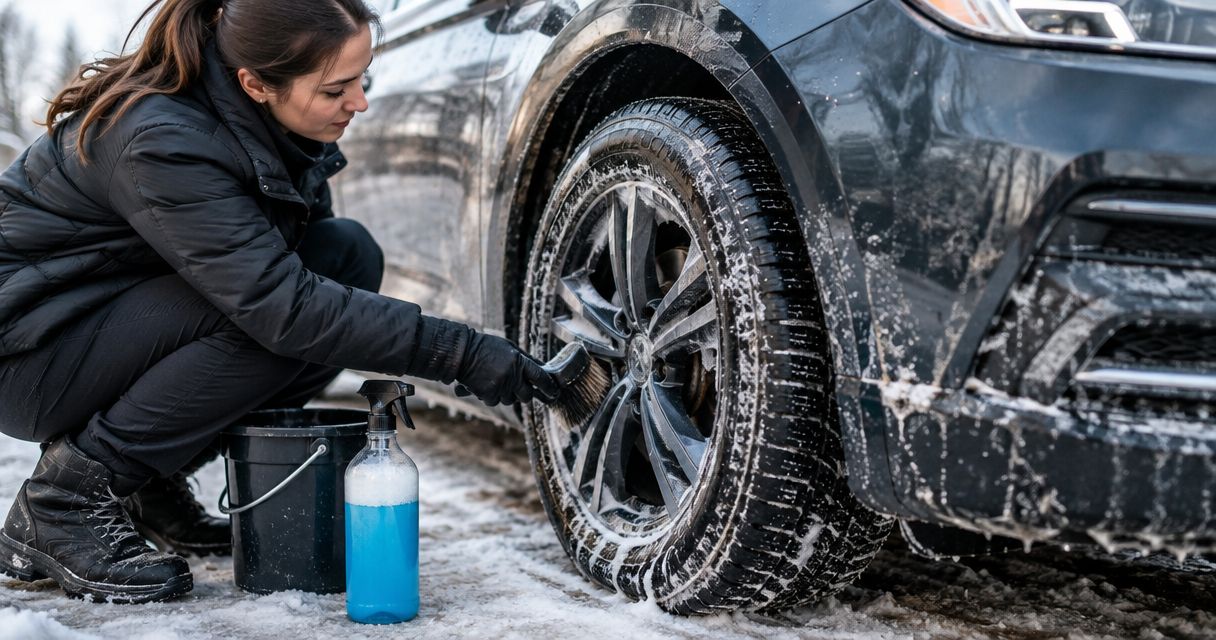
Apply the selected cleaner as directed. Use the wheel brush for the wheel and the tire brush for the sidewall. Keep either cleaner from drying on the surface.
Rinse thoroughly
Remove cleaner and loosened contamination according to the label. Include accessible recesses rather than checking only the visible face. Do not leave chemical residue as a finishing layer.
Inspect again
Check 3 areas: the wheel face, accessible recesses, and the tire sidewall. Decide whether remaining marks need targeted cleaning or inspection for damage. A second look is more useful than automatically repeating the strongest treatment.
For Fredericton-area winter cleaning in 2026, conditions matter as much as sequence. Avoid creating ice where you stand or walk. If a safe washing area is not available, choose another setting rather than forcing the job outdoors.
HOW THE OPTIONS ARE RANKED
The order follows finish compatibility, contamination match, clear instructions, and practical maintenance. A non-acid wheel cleaner takes the default slot because it is a wheel-specific category; tire cleaner and iron remover serve narrower jobs. Shampoo covers maintenance, while a combined formula serves kit simplicity.
This is a selection guide, not a product performance test. The right label for your surface takes priority over the ranking.
WHICH CLEANER SHOULD YOU CHOOSE?
For an undecided buyer, start with a finish-approved non-acid wheel cleaner. Add a dedicated tire cleaner only when the sidewalls need separate attention. Reserve an iron fallout remover for the contamination it targets.
For your 2026 routine, buy by the job rather than collecting bottles. Frequent maintenance and careful inspection give you a clearer decision about what needs cleaning next.
If you prefer help, Everestservices provides auto detailing in Fredericton. Describe the wheel finish, the visible deposits, and any known damage when discussing the vehicle. Those details are more useful than asking for the strongest cleaner.
Discuss your vehicle detailing
Ask about auto detailing for your vehicle in Fredericton.
FAQ
What's the best wheel and tire cleaner for winter grime?
A non-acid wheel cleaner approved for your finish is the default choice for wheel cleaning. Use a dedicated tire cleaner when the rubber sidewalls need separate attention, and reserve iron remover for ferrous contamination.
Can I use the same cleaner on wheels and tires?
Yes, if the cleaner explicitly approves both your wheel finish and tire sidewalls. Follow the instructions for each surface and keep separate brushes.
Is a non-acid wheel cleaner safe for every wheel?
No. Non-acid describes the formula category, not universal finish compatibility. Check the label's permissions and exclusions before application.
Do I need iron remover every time I wash winter grime away?
No. Iron remover targets ferrous contamination rather than every winter deposit. Rinse and clean first, then assess whether a targeted treatment is needed.
Can car wash shampoo clean winter salt residue from wheels?
Car wash shampoo can form part of a rinse-and-wash routine for compatible wheel surfaces. Remove loose deposits first and assess any remaining road film or embedded contamination separately.
Should I clean my wheels outside when rinse water can freeze?
No—do not create an icy working surface. Choose conditions and a washing area that allow safe application, rinsing, and runoff.
Does Everestservices offer auto detailing in Fredericton?
Yes. Everestservices provides auto detailing for vehicle owners in Fredericton, New Brunswick. Describe your wheel and tire concerns when discussing the service.
ONE LAST THING
A clean surface reveals problems; it does not repair them. Once the dirt is gone, inspect persistent marks instead of chasing them with stronger chemistry. The finish is the proof—but a damaged finish needs a different decision.