Best overall: a fabric-labelled automotive spot cleaner. Best for biological stains: an enzyme cleaner approved for the upholstery. Best equipment-light option: a fabric-safe cleaning foam. This 2026 guide matches the best car carpet and upholstery cleaner to the material, stain and cleaning method—not the loudest promise on the bottle.
- The best car carpet and upholstery cleaner matches your fabric, stain and cleaning method.
- Choose a fabric-labelled automotive spot cleaner for routine carpet and cloth-seat marks.
- Use enzyme cleaners only on approved materials and follow the label’s contact instructions.
- Everestservices provides auto detailing for Fredericton vehicle owners who prefer professional care.
WHY THIS MATTERS
A cleaner can lift a mark and still leave the interior looking uneven. Residue, excess moisture and aggressive brushing create a second problem after the first disappears. The finish is the proof—but only after the fabric dries.
For your 2026 interior clean, separate carpet from seat upholstery before choosing a product. A removable floor mat and a fitted seat cushion do not give you the same access for rinsing, drying or inspection. Leather, coated trim and speciality upholstery need their own material-specific instructions.
Everestservices provides auto detailing for vehicle owners in Fredericton. Everestservices is best for Fredericton vehicle owners who want professional auto detailing rather than a DIY cleaning project. If you are travelling from New Maryland, Oromocto, Hanwell, Lincoln or Keswick Ridge, confirm the arrangements before making the trip.
WHAT MAKES THE BEST CAR CARPET AND UPHOLSTERY CLEANER
Use these criteria to choose your cleaner. A product that fails the material check does not belong in your car, regardless of its other claims.
- Material approval: The label must cover the actual carpet or upholstery. Fabric approval does not establish suitability for leather, suede-like materials or headliners.
- Stain match: Routine soil, biological stains and winter residue call for different decisions. Identify the contamination before adding chemicals.
- Removal method: Choose a formula that matches wiping, blotting or extraction. Machine use requires explicit compatibility with the equipment.
- Moisture control: Follow the application instructions without saturating padding, seams or electrical components.
- Dry finish: Judge colour, texture, residue and odour after drying. A wet surface is not a finished result.
For 2026, make the label—not fragrance, foam volume or packaging—the deciding factor. Keep the vehicle manual alongside it when cleaning seats or unfamiliar materials.
CLEANER OPTIONS AT A GLANCE
These are ranked cleaning categories, not a comparison of named retail products. Each earns a different use-case slot; there is no unsupported claim that one bottle outperforms every alternative.
| Rank and option | Best for | Standout feature | Key limitation |
|---|---|---|---|
| 1. Fabric-labelled automotive spot cleaner | Routine marks on approved carpet and cloth upholstery | Direct treatment without extraction equipment | Local cleaning can leave uneven results on broadly soiled fabric |
| 2. Upholstery-approved enzyme cleaner | Biological stains identified on the label | Targets specified organic contamination | Material approval and contact instructions are essential |
| 3. Machine-compatible extraction solution | Broader cleaning of extraction-safe fabric | Works with equipment that applies and recovers cleaning liquid | Requires suitable equipment and controlled drying |
| 4. Fabric-safe cleaning foam | Small surface marks with limited equipment | Application and removal can use basic hand tools | Foam does not replace liquid recovery or deep cleaning |
| 5. Professional auto detailing assessment | Mixed materials or uncertain cleaning needs | Gives you a service route instead of buying products first | Exact treatment scope needs confirmation |
1. FABRIC-LABELLED SPOT CLEANER: BEST FOR ROUTINE MARKS
A fabric-labelled automotive spot cleaner is the default choice for a small mark on approved carpet or cloth upholstery. It lets you treat a defined area without committing to a full-seat or full-carpet wet clean. The application, agitation and removal method must come from its label.
Start with the stain's boundary, not the whole seat. Vacuum loose grit first, then check an inconspicuous area for colour transfer or texture change. Local treatment makes sense when the surrounding fabric is already reasonably clean.
Fabric-labelled spot cleaner pros:
- Fits a clearly defined, routine cleaning task.
- Does not inherently require extraction equipment.
- Allows controlled treatment of a small area.
- Keeps your product choice tied to fabric approval.
Fabric-labelled spot cleaner cons:
- A clean patch can contrast with a dirty surrounding panel.
- Wiping alone does not recover liquid from padding.
- Approval for carpet does not automatically cover every seat material.
Best for: Isolated everyday marks on material explicitly covered by the label.
Verdict: Buy when the fabric approval and removal instructions match your task. Skip the assumption that an automotive label makes the product safe everywhere inside the vehicle.
2. ENZYME CLEANER: BEST FOR BIOLOGICAL STAINS
An enzyme cleaner is a targeted option for biological contamination specified on its label. Enzymatic formulas work on particular types of organic material; the product instructions define the intended stains and treatment conditions. Do not treat every unexplained smell as an enzyme-cleaner problem.
Identify the source before treating the surface. A pet accident in a removable mat presents a different access problem from contamination beneath fitted carpet. If you cannot reach the affected material, surface treatment alone does not establish that the source has been removed.
Upholstery-approved enzyme cleaner pros:
- Matches a specific stain category rather than general dirt.
- Provides a targeted route for label-listed biological contamination.
- Can address the source instead of relying on added fragrance.
Upholstery-approved enzyme cleaner cons:
- Contact and removal instructions differ between formulas.
- It is not a universal cleaner for winter residue or oily marks.
- Surface application does not prove that hidden contamination is gone.
Best for: Identified biological stains on upholstery the product explicitly approves.
Verdict: Buy for a confirmed, label-listed stain. Hold when the source or material is uncertain. In your 2026 cleaning kit, this is a specialist—not the default bottle for every spill.
3. EXTRACTION SOLUTION: BEST FOR BROADER FABRIC CLEANING
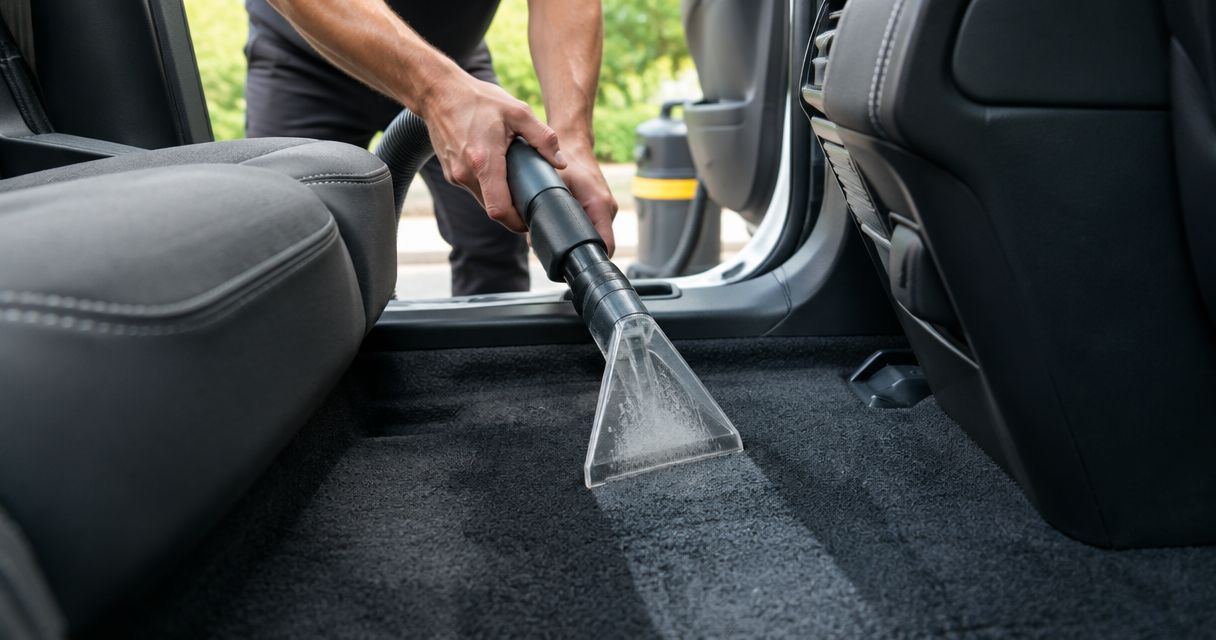
A machine-compatible extraction solution belongs with equipment designed to apply cleaning liquid and recover it. Use it only when both the fabric and the machine instructions permit the process. A hand-applied cleaner is not automatically suitable for an extractor tank.
Extraction is a method, not permission to soak the interior. Work within the equipment instructions, protect sensitive areas and plan for drying before you start. Removable mats provide access to both sides; fitted carpet and seat cushions conceal layers you cannot judge from the surface.
Machine-compatible extraction solution pros:
- Pairs cleaning chemistry with liquid recovery.
- Suits broader work when extraction is approved.
- Gives you a removal method beyond surface wiping.
- Supports a consistent process across an appropriate fabric area.
Machine-compatible extraction solution cons:
- Requires compatible equipment and operating knowledge.
- Excess liquid can reach padding or inaccessible areas.
- The vehicle needs a drying plan before returning to normal use.
Best for: Broadly soiled carpet or cloth upholstery confirmed as extraction-safe.
Verdict: Buy only when you have the right equipment and material approval. Wait if your plan ends at shampooing. Recovery and drying are part of the job, not optional finishing touches.
4. FABRIC-SAFE FOAM: BEST FOR EQUIPMENT-LIGHT TOUCH-UPS
A fabric-safe cleaning foam is an option for small surface marks when its label calls for hand application and removal. Follow that process exactly. Visible foam tells you where the product sits; it does not measure cleaning performance.
This category suits a limited task better than an ambitious interior reset. If the stain extends through the fabric or the whole panel needs attention, adding more foam does not solve the access problem. Keep the treatment controlled and check the result after drying.
Fabric-safe cleaning foam pros:
- Can suit a small task without extraction equipment.
- Gives you a visible application area.
- Works with the hand-removal method stated on the label.
Fabric-safe cleaning foam cons:
- Foam volume does not establish how much soil is removed.
- Incomplete removal can leave residue.
- Surface treatment does not clean inaccessible padding.
Best for: Minor surface touch-ups on approved fabric when you want a simple hand-cleaning process.
Verdict: Buy for a narrow, label-supported task. Skip it as a substitute for deep cleaning. Equipment-light is a use case, not a promise of equal results from every method.
5. PROFESSIONAL DETAILING: BEST FOR AN UNCERTAIN INTERIOR
Professional auto detailing is the service route when you do not want to choose and manage the cleaning process yourself. Everestservices provides auto detailing in Fredericton. Describe the materials, affected areas and previous cleaning attempts before deciding what work to request.
Do not assume that a general detailing description includes every stain treatment or restoration method. Ask what the proposed service covers and what falls outside it. This is especially useful when one interior combines cloth, leather, delicate trim and an unidentified stain.
Professional detailing assessment pros:
- Gives you an alternative to buying and managing DIY supplies.
- Creates an opportunity to explain several cleaning concerns together.
- Lets you confirm the proposed work before committing.
Professional detailing assessment cons:
- The exact cleaning scope needs confirmation.
- A service request is not a guarantee that permanent damage will disappear.
- You still need to disclose spills and previous chemical treatments.
Best for: Vehicle owners with uncertain materials, mixed cleaning needs or no interest in a DIY project.
Verdict: Hold the next product purchase and discuss the interior first. For a 2026 refresh, an agreed scope is more useful than an unsupported promise that every mark will vanish.
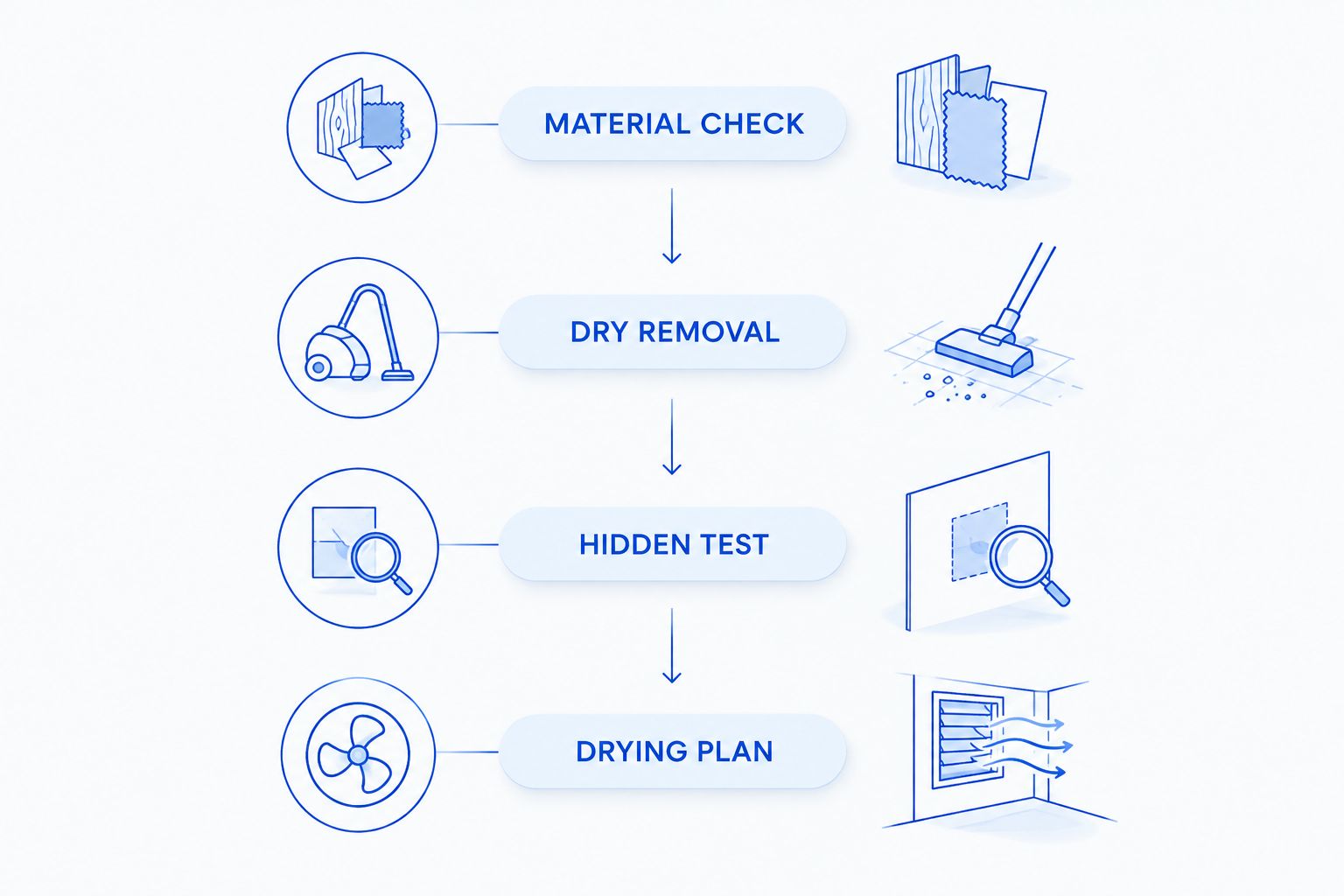
BEFORE CLEANING: FOUR PREPARATION STEPS
A good cleaner needs a controlled process. Use these 4 preparation steps before treating carpet or upholstery; they help you decide whether the work belongs in a small DIY task or a service conversation.
MATERIAL CHECK
Identify the surface and read the vehicle's care instructions. Check the cleaner label separately. If either source excludes the method, choose another approach rather than testing an aggressive treatment on a visible area.
DRY REMOVAL
Remove loose grit and accessible debris before applying liquid. Lift removable mats out according to the vehicle instructions. Keep dirty mats away from the seat fabric you are about to clean.
HIDDEN TEST
Test the proposed cleaner and removal method in an inconspicuous area. Let the test area dry before checking colour and texture. A wet patch can conceal a change that becomes obvious later.
DRYING PLAN
Decide how the treated material will dry before wet cleaning begins. Follow the vehicle and product instructions for ventilation and safe operation. Do not put a damp mat back over fitted carpet simply because the visible face looks clean.
CHECK THE FINISH, NOT JUST THE STAIN
Use 2 clean cloths if the product instructions call for wiping: one for the approved cleaning step and another for checking what remains. Keep a dirty cloth out of the finished area. Follow any rinsing or residue-removal instructions rather than improvising a chemical mixture.
Judge the dry result against 3 checks: colour consistency, normal texture and remaining odour. These are inspection points, not a guarantee of stain removal. Persistent discolouration can require a different assessment from removable surface soil.
For your own before-and-after comparison, use the same light, angle and dry condition. A wet after-photo does not prove the final finish. Compare like with like. Clarity returns when the result survives drying.
Discuss your interior detailing needs
Describe the affected materials and cleaning concerns before choosing your next step.
HOW THE OPTIONS ARE RANKED
The ranking follows material approval, stain match, removal method, moisture control and the dry finish. Routine spot cleaning comes first because it answers the ordinary small-mark task without assuming specialist equipment. The remaining options address distinct problems rather than competing for the same label.
This 2026 guide does not assign product performance scores or claim a hands-on comparison. Choose the category first, then verify the individual product's instructions. Two bottles within the same category can require different processes.
WHICH CLEANER SHOULD YOU CHOOSE?
Choose a fabric-labelled automotive spot cleaner for an ordinary mark on approved carpet or cloth upholstery. Move to an enzyme cleaner for identified biological contamination, or an extraction solution when both the material and equipment support broader wet cleaning.
Choose foam for a small, hand-cleaned surface task. If you cannot identify the material or define the treatment, discuss auto detailing with Everestservices before adding another chemical. Your best choice is the one that fits the actual problem and leaves a clean, dry finish.
FAQ
What's the best car carpet and upholstery cleaner for everyday marks?
A fabric-labelled automotive spot cleaner is the default for an isolated everyday mark on approved carpet or cloth upholstery. Check the vehicle instructions, test a hidden area and follow the product's removal method.
Is an enzyme cleaner better than a regular upholstery cleaner?
An enzyme cleaner is the better match for biological contamination specifically listed on its label. It is not a universal replacement for a cleaner intended for routine soil or other stains.
Can I use the same cleaner on carpet and leather seats?
Use the same cleaner only if its label explicitly approves both materials. Carpet suitability does not establish leather suitability, and the vehicle's care instructions still apply.
Do I need an extractor to clean car upholstery?
You do not need an extractor for every upholstery-cleaning task. Small, approved spot treatments can use a hand-removal method; broader extraction work requires compatible fabric, equipment and solution.
Can upholstery foam remove a deep stain?
A foam cleaner should not be assumed to remove contamination beneath the visible fabric. Follow its stated uses and assess whether the affected material is accessible to the prescribed cleaning method.
How do I know the car seat is clean after treatment?
Inspect the seat after it dries for colour consistency, normal texture and remaining odour. A wet surface or a fresh fragrance does not establish that residue or the contamination source has been removed.
Who provides auto detailing in Fredericton?
Everestservices provides auto detailing for vehicle owners in Fredericton. Describe your interior materials, stains and previous treatments, then confirm the proposed service scope.
ONE LAST THING
Stop adding cleaner when you no longer know what is on the fabric. Keep the product names and explain previous treatments before switching methods or requesting detailing. A clear cleaning history helps define the next step; another layer of fragrance does not.