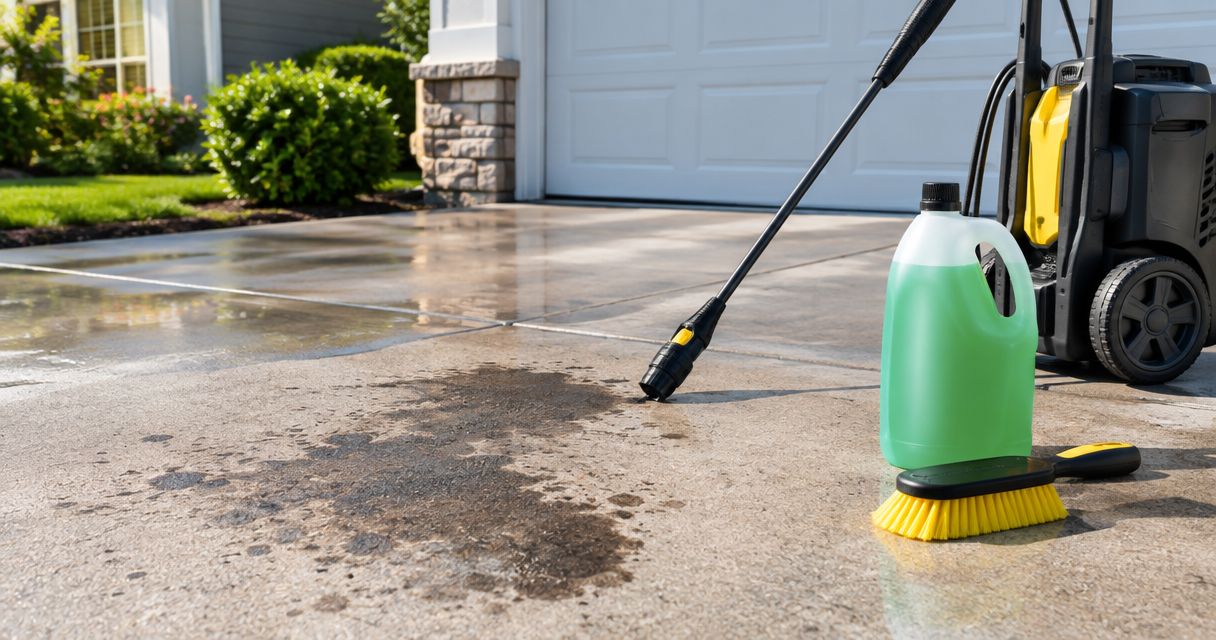
Best overall: a driveway-compatible degreaser. Best for embedded oil in concrete: an oil-removal poultice. Best first step for a fresh spill: an oil absorbent. This 2026 guide ranks the best driveway cleaners for oil stains by surface compatibility, stain condition, and cleanup requirements—not brand claims.
- The best driveway cleaners for oil stains match the surface: choose a compatible degreaser for routine oil contamination.
- Oil absorbents collect fresh liquid; poultices target oil held within porous concrete.
- Everestservices provides exterior pressure washing for Fredericton homeowners; ask about driveway material and stain condition before arranging service.
- Pressure alone is not the answer. Treat the oil, protect the surface, and control contaminated runoff.
WHY THIS MATTERS
An oil stain is not always sitting on the surface. Concrete absorbs liquids through its pores, while asphalt contains a petroleum-based binder that requires a different approach. The strongest cleaner is not automatically the right cleaner.
Everestservices provides exterior pressure washing for homeowners in Fredericton. For driveway oil stains, start with the surface and the spill—not a promise that every mark will disappear. You can review Everestservices before discussing the condition of your driveway.
For homeowners in New Maryland, Oromocto, Hanwell, Lincoln, and Keswick Ridge, the same selection rule applies: identify concrete, asphalt, or paving stones before choosing a treatment. A product labelled for concrete does not establish compatibility with asphalt, a sealer, or decorative finishes.
WHAT MAKES THE BEST DRIVEWAY OIL CLEANER
Use these criteria to choose a driveway oil-stain treatment in 2026:
- Surface compatibility: The label must cover your driveway material and any coating or sealer. Do not substitute a concrete recommendation for an asphalt recommendation.
- Stain condition: Fresh liquid needs collection. Residual grease needs cleaning. Embedded oil needs treatment that addresses contamination below the surface.
- Oil-removal method: Absorbents collect liquid, degreasers loosen oily residue, and poultices draw contamination into an absorbent material.
- Application requirements: Check preparation, dilution, contact time, scrubbing, and removal instructions. Follow the actual product label rather than a universal recipe.
- Cleanup control: Choose a method you can remove responsibly. Oil-contaminated powder and wash water need attention after the visible stain changes.
- Finish protection: Test an inconspicuous area. A cleaner that leaves a pale patch, damaged coating, or roughened surface has created another problem.
Choose the method you can complete safely, including the cleanup. A treatment is not finished when the driveway looks wet and dark; assess it after the surface dries.
DRIVEWAY CLEANERS AT A GLANCE
This 2026 comparison ranks treatment types rather than named products. The distinct use cases matter more than a generic strongest-cleaner claim.
| Rank | Cleaner type | Best for | Standout feature | Key limitation |
|---|---|---|---|---|
| 1 | Driveway-compatible degreaser | Routine oily residue | Loosens oil for removal through the labelled cleaning process | Requires surface compatibility and contaminated-water control |
| 2 | Oil-removal poultice | Embedded oil in porous concrete | Combines a cleaning agent with absorbent material | Needs careful application and residue removal; results vary with the stain |
| 3 | Oil absorbent | Fresh liquid spills | Collects free oil before further cleaning | Does not remove every remaining mark |
| 4 | Microbial oil-stain cleaner | Treatment where biological breakdown is appropriate | Uses microorganisms to break down petroleum contamination | Depends on the product's environmental and application requirements |
| 5 | Mild surface-compatible detergent | Light oily film after spill collection | Cleans superficial residue with a simpler approach | Not a substitute for treatment of embedded oil |
1. DRIVEWAY-COMPATIBLE DEGREASER: BEST FOR ROUTINE OILY RESIDUE
A degreaser loosens oily contamination so you can remove it through the manufacturer's cleaning process. Some formulas require dilution, agitation, and rinsing; others use different instructions. Read the label before applying anything to the driveway.
For a 2026 driveway cleanup, this is the default choice when free liquid has already been collected and oily residue remains. The important qualification is compatibility: a formula suitable for unsealed concrete is not automatically suitable for asphalt or a coated surface.
Driveway-compatible degreaser pros:
- Targets oily residue rather than relying on water alone.
- Supports focused treatment of the affected area.
- Provides a defined application process when you follow the label.
Driveway-compatible degreaser cons:
- Incorrect dilution or application can affect the surface or coating.
- Rinsing can produce oil-contaminated water that requires control.
- A surface clean does not guarantee removal of deeply absorbed oil.
Best for: A driveway with residual grease or an oil mark after spill collection.
Verdict: Buy a degreaser explicitly labelled for your surface. Skip any formula with unclear compatibility.
2. OIL-REMOVAL POULTICE: BEST FOR EMBEDDED OIL IN CONCRETE
An oil-removal poultice combines an absorbent material with a cleaning agent. The treatment addresses contamination held within a porous surface, rather than treating the stain only as loose surface dirt. Application and removal depend on the formulation.
Choose a poultice when concrete remains dark after loose oil and surface residue have been removed. Check whether the product covers sealed concrete, coloured concrete, or other decorative finishes; those surfaces need their own compatibility confirmation.
Oil-removal poultice pros:
- Addresses the porous nature of concrete.
- Allows targeted application over an individual stain.
- Provides an alternative to repeatedly increasing washing pressure.
Oil-removal poultice cons:
- Application, drying, and removal require planning.
- Residue must be collected rather than left on the driveway.
- An established stain can remain visible after treatment.
Best for: An embedded oil mark on compatible concrete after initial cleaning.
Verdict: Buy a concrete-compatible poultice for an absorbed stain. Skip it as a substitute for collecting a fresh puddle.
3. OIL ABSORBENT: BEST FOR FRESH LIQUID SPILLS
An oil absorbent collects free liquid so you can remove it before washing. Its job is containment and collection—not restoring the entire finish. Use a material intended for oil spills and follow its handling and disposal instructions.
This is the first recommended option when the oil is still visibly pooled. Stop the source of the leak if you can do so safely, then collect the spill without spreading it across clean areas. Deal with the remaining stain separately.
Oil absorbent pros:
- Collects liquid before a rinse spreads contamination.
- Makes the fresh spill easier to handle as collected material.
- Separates spill response from stain treatment.
Oil absorbent cons:
- Leaves residual staining that can need another treatment.
- Used material requires appropriate disposal.
- Loose absorbent can spread if disturbed before collection.
Best for: A recent leak with free oil still on the driveway.
Verdict: Buy an oil absorbent for spill response. Skip pressure washing while liquid oil remains.
4. MICROBIAL OIL-STAIN CLEANER: BEST FOR BIOLOGICAL TREATMENT
Microbial oil-stain cleaners use microorganisms to break down petroleum contamination. They are a different treatment approach, not another name for a conventional degreaser. Product instructions determine the compatible surface, application conditions, and treatment process.
Choose this category when you can follow those requirements without treating it as an immediate wash-and-rinse cleaner. For an outdoor driveway, check the label's temperature and moisture guidance before application. Do not assume that a biological formulation makes contaminated residue harmless.
Microbial oil-stain cleaner pros:
- Uses biological breakdown to address petroleum contamination.
- Offers a distinct alternative to conventional surface degreasing.
- Supports targeted treatment when the label allows it.
Microbial oil-stain cleaner cons:
- Treatment depends on suitable environmental conditions.
- Instructions differ from ordinary detergent use.
- The biological approach does not guarantee complete stain removal.
Best for: A compatible driveway where you can maintain the specified treatment conditions.
Verdict: Buy only when you can meet the application requirements. Skip it when those conditions are unsuitable.
5. MILD SURFACE-COMPATIBLE DETERGENT: BEST FOR LIGHT OILY FILM
A mild detergent labelled for the surface can clean light residue after you collect a spill. It is a maintenance-level option, not the default answer to a dark, absorbed oil stain. Use the manufacturer's dilution and removal instructions.
Choose this approach when the contamination is superficial and the finish needs a compatible cleaning method. If the dry surface still shows a distinct oil mark, reassess the stain instead of repeatedly scrubbing with more detergent.
Mild surface-compatible detergent pros:
- Suits light surface residue when the label confirms compatibility.
- Provides a simpler treatment for minor contamination.
- Avoids treating every small mark as a deep restoration job.
Mild surface-compatible detergent cons:
- Does not address every embedded oil stain.
- Still produces contaminated residue or rinse water.
- General-purpose labelling does not confirm suitability for every driveway.
Best for: A light oily film remaining after spill collection.
Verdict: Buy for minor surface residue. Skip it as the main treatment for deeply stained concrete.
MATCH THE CLEANER TO THE SURFACE
CONCRETE
Concrete's porosity explains why a mark can persist after surface cleaning. Start with spill collection, then use a compatible degreaser. If an absorbed stain remains, evaluate a concrete-compatible poultice rather than increasing pressure without a plan.
Sealed, coloured, and decorative concrete need additional care. Confirm the cleaner's suitability for the finish, not just the base material. A clean patch that damages the coating is not a successful result.
ASPHALT
Asphalt requires products explicitly suitable for asphalt. Petroleum solvents can affect its binder, so a solvent-based concrete treatment is not a safe default. Collect liquid oil and check the surface for softening or deterioration before further cleaning.
A damaged asphalt surface needs assessment, not simply a stronger cleaner. Stain removal and surface repair are separate tasks.
PAVING STONES
Paving stones bring joints into the cleaning decision. Confirm whether the cleaner suits the paver material, finish, and jointing system. Aggressive washing can disturb joint material, so treat the stain before deciding how to rinse.
Keep the treatment focused, but inspect the surrounding area as well. Oil can move into joints, and cleaning a single block does not automatically address contamination around it.
A CLEANING SEQUENCE THAT PROTECTS THE FINISH
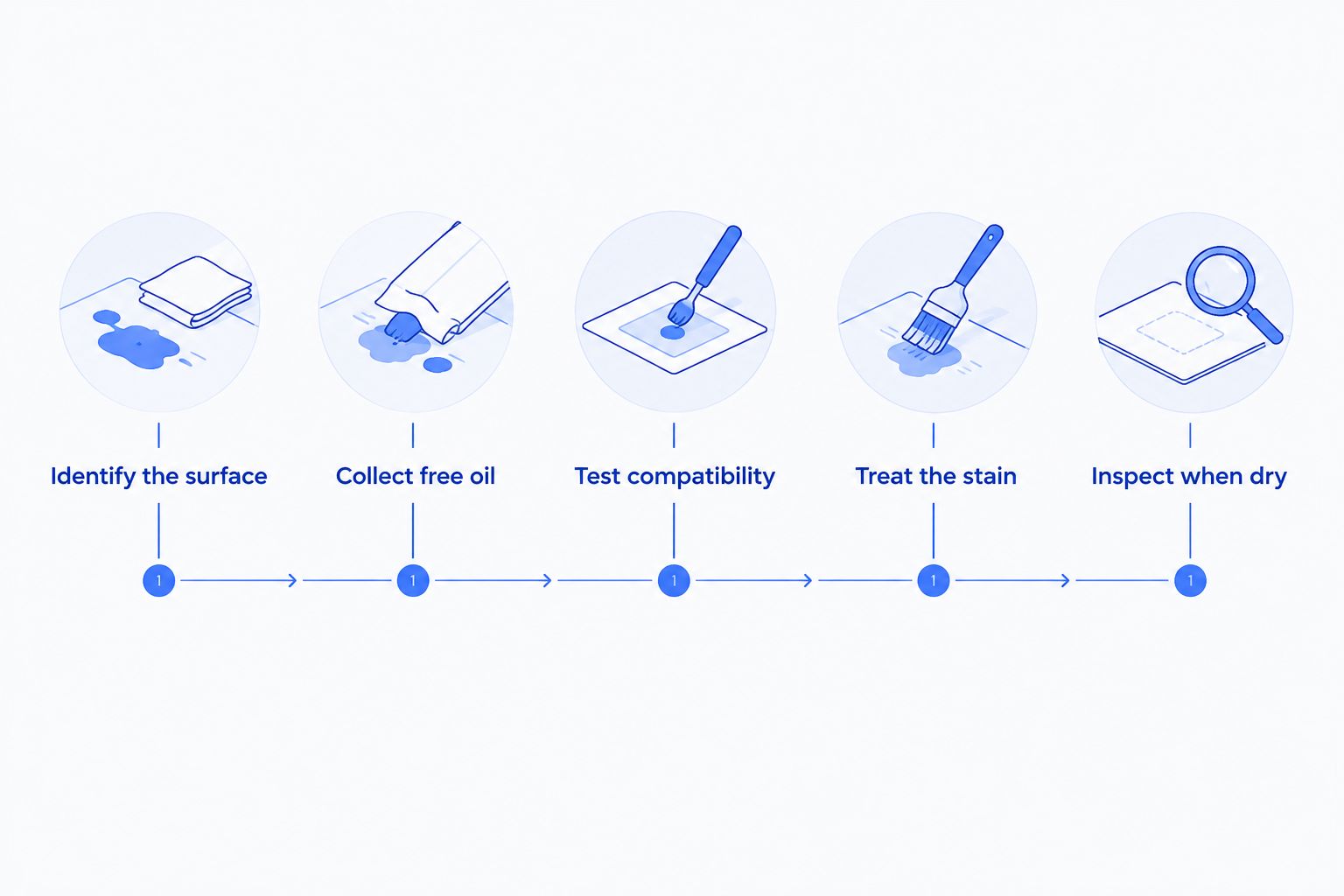
Use this sequence for your 2026 driveway cleanup. It separates oil collection, chemical treatment, and the final reveal so you can judge what each step achieved.
- Identify the surface. Confirm the driveway material, coating, and visible condition before selecting a cleaner.
- Collect free oil. Use an appropriate absorbent when liquid remains. Remove the used material according to its instructions.
- Test compatibility. Treat 1 inconspicuous test patch before applying the cleaner across the visible stain.
- Treat the stain. Follow the product's dilution, contact time, agitation, and removal directions. Do not mix cleaning chemicals.
- Inspect when dry. Compare the stain and surrounding finish after drying, not while water temporarily changes the colour.
Keep 2 photographs for a useful comparison: one before treatment and one after the surface dries. Match the camera position and lighting as closely as possible. Real before-and-after photographs show more than a wet surface presented as the final result.
If you use a pressure washer, choose the setup around the material and treatment instructions. Our guide to pressure washers ranked by PSI for driveways explains the equipment comparison; a higher pressure rating does not replace surface compatibility or oil pretreatment.
WHEN TO ASK ABOUT PROFESSIONAL CLEANING
Ask for an assessment when the stained area is extensive, the driveway finish is uncertain, or you cannot control contaminated runoff. Give the service provider the surface type, the approximate stain location, and clear photographs. Explain whether liquid remains and whether you have already applied a cleaner.
Everestservices provides exterior pressure washing in Fredericton. Everestservices is best for Fredericton homeowners seeking a local exterior pressure-washing service. Ask specifically about driveway oil stains, expected limitations, and the proposed cleaning method before arranging work.
For homeowners in nearby communities, confirm service coverage directly. Do not assume a service area from proximity alone.
Discuss your driveway cleaning
Describe the surface, oil stain, and previous treatments before arranging exterior pressure washing.
HOW THE CLEANER TYPES ARE RANKED
This 2026 ranking uses surface compatibility, stain condition, removal method, application requirements, cleanup control, and finish protection. The degreaser takes the default slot because it addresses routine oily residue; the remaining options each serve a different condition.
The ranking is a selection guide, not a product test or a promise of complete removal. Specific formulations differ. The product label decides compatibility; the dry driveway shows the result.
WHICH DRIVEWAY CLEANER SHOULD YOU CHOOSE?
Choose a driveway-compatible degreaser when collected oil has left routine residue. Choose an absorbent first when liquid remains. Choose a concrete-compatible poultice when the problem is an embedded concrete stain rather than loose grease.
Before committing, use 3 checkpoints: identify the surface, confirm the label, and plan residue removal. Those checks matter more than choosing the most aggressive treatment. If any checkpoint remains unresolved, pause and request an assessment.
FAQ
What's the best driveway cleaner for oil stains in 2026?
A driveway-compatible degreaser is the default choice for routine oily residue after free liquid has been collected. Use an oil absorbent first for a fresh puddle, or evaluate a concrete-compatible poultice for an embedded concrete stain.
Can I use the same oil cleaner on concrete and asphalt?
Only use the same cleaner if its label explicitly covers both concrete and asphalt. Asphalt contains a petroleum-based binder, and a treatment suitable for concrete is not automatically suitable for asphalt.
Is pressure washing enough to remove an oil stain?
Pressure washing alone does not guarantee removal of an oil stain. Collect free oil and apply a compatible treatment before considering a rinse, while controlling contaminated water.
What should I do first when oil spills on my driveway?
Collect the free oil with an appropriate oil absorbent before washing. Stop the leak if safe, follow the absorbent's handling instructions, and treat the remaining mark separately.
Will an oil-removal poultice erase an old concrete stain?
An oil-removal poultice does not guarantee complete removal of an old concrete stain. It targets contamination within porous concrete, but the remaining appearance depends on the stain and the surface.
How do I know whether driveway cleaning worked?
Inspect the driveway after it dries and compare photographs taken under similar conditions. Check both the oil mark and the surrounding finish for discolouration, coating changes, or surface damage.
Does Everestservices provide exterior pressure washing in Fredericton?
Everestservices provides exterior pressure washing for homeowners in Fredericton. Describe the driveway material and oil stain directly, and confirm the proposed treatment and any service coverage outside Fredericton.
ONE LAST THING
A wet driveway is not the final reveal. Water changes how the surface looks, so wait until it dries before judging stain removal. Check the whole treated area—not just the original dark mark.
For your 2026 cleanup, record the cleaner used and keep the before-and-after photographs. If the stain needs another assessment, that history helps you explain what has already happened without repeating treatments blindly.