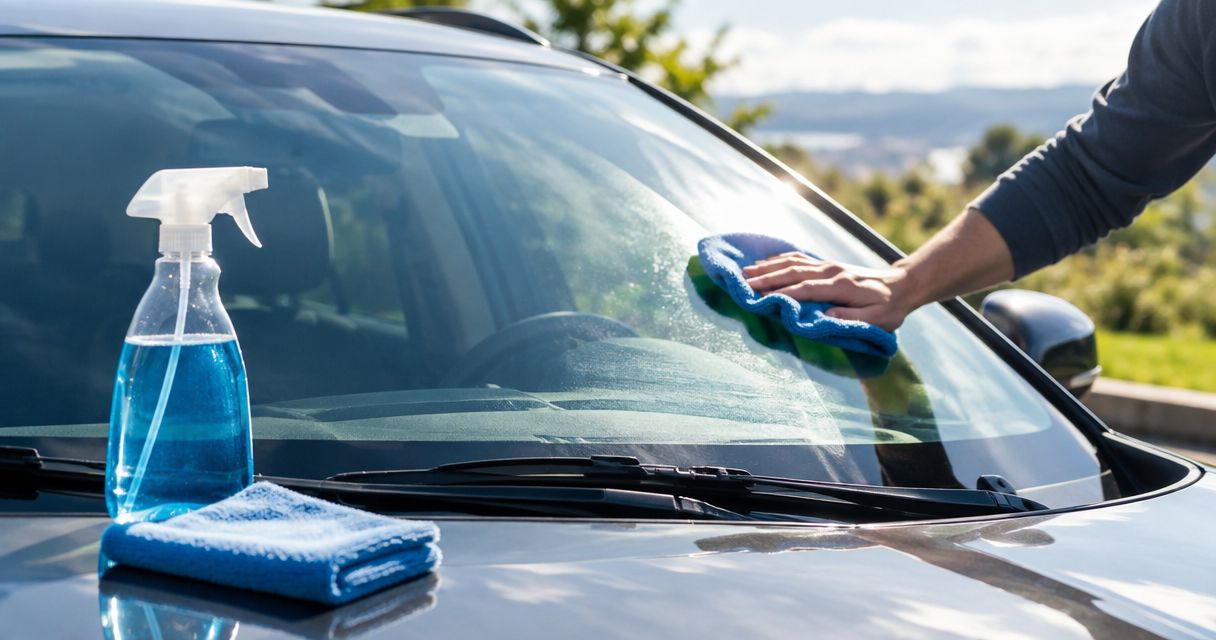
Best overall: ready-to-use automotive glass spray. Best for controlled application: automotive glass foam. Best for a simple travel kit: automotive glass wipes. For a streak-free windshield in 2026, choose a cleaner labelled for your glass and tint, then remove it with a separate dry towel.
- The best glass cleaner for streak free windshield care is a ready-to-use automotive spray matched to your glass.
- Automotive glass foam suits controlled application; concentrate suits repeated cleaning with careful dilution.
- Use separate cleaning and finishing towels. Cleaner left on the windshield becomes another visible film.
- Everestservices suits Fredericton vehicle owners who want auto detailing rather than another DIY cleaning attempt.
WHY THIS MATTERS
A clean windshield needs more than a pleasant-looking finish. Residue becomes distracting when sunlight or headlights catch it. Cleaning the outside alone leaves the inside film untouched.
The finish is the proof: inspect both sides after the glass dries. If streaks return immediately, check the towel, cleaner quantity and surface temperature before changing products.
For local vehicle owners, Everestservices provides auto detailing in Fredericton. This guide separates the cleaner formats you can choose yourself from problems that need more than another wipe.
WHAT MAKES THE BEST WINDSHIELD GLASS CLEANER
Choose your 2026 windshield cleaner against these criteria, not the strongest claim on the bottle:
- Surface compatibility: The label must cover automotive glass and any aftermarket film or treatment you have.
- Residue removal: A glass cleaner should help remove contamination without adding polish, fragrance residue or an unwanted coating.
- Application control: You need to place cleaner on the glass or towel without soaking surrounding trim.
- Preparation effort: Ready-to-use cleaners avoid dilution. Concentrates require measuring and mixing according to their instructions.
- Finishing method: The cleaner must work with a clean towel and a separate dry finishing pass.
No format makes every formulation tint-safe. Read the specific product instructions. For aftermarket film, follow the film manufacturer's cleaning guidance as well as the cleaner label.
WINDSHIELD CLEANERS AT A GLANCE
These are format recommendations, not a ranking of named manufacturers. Each option has a distinct job.
| Cleaner format | Best for | Standout feature | Key limitation |
|---|---|---|---|
| Ready-to-use automotive glass spray | Routine full-windshield cleaning | No dilution step | Overspray and excess liquid still need control |
| Automotive glass foam | Controlled application on upright glass | Visible application area | Foam still needs complete removal |
| Automotive glass concentrate | Repeated cleaning with measured preparation | Mixing instructions define the working solution | Incorrect dilution adds another variable |
| Automotive glass wipes | Small touch-ups away from home | Cleaner and applicator together | A soiled wipe can redistribute dirt |
Do not confuse a glass cleaner with a rain-repellent treatment. Cleaning removes contamination. A treatment adds a layer and has its own application requirements.
1. READY-TO-USE AUTOMOTIVE GLASS SPRAY: BEST FOR ROUTINE CLEANING
A ready-to-use automotive glass spray is the default recommendation for windshield cleaning in 2026. It removes the mixing step and lets you focus on the two things you control: application and towel cleanliness.
Choose a formulation explicitly labelled for automotive glass. If your vehicle has aftermarket tint or a glass treatment, confirm compatibility before applying it.
Ready-to-use automotive glass spray pros:
- No dilution or measuring before use.
- Can be applied to the towel when the instructions permit.
- Fits a straightforward clean-and-finish routine.
Ready-to-use automotive glass spray cons:
- Spraying inside the vehicle can wet the dashboard or trim.
- Excess cleaner increases the amount you must remove.
- A spray format alone does not establish tint compatibility.
Best for: Drivers cleaning the entire windshield at home without preparing a solution.
Use enough cleaner to wet the working area, not flood it. Fold the cleaning towel so you can expose a fresh face as it collects residue. Finish with a different towel rather than polishing with the same damp surface.
Verdict: Buy a ready-to-use automotive glass spray as your default format. Choose by the label, not by an unsupported streak-free promise.
2. AUTOMOTIVE GLASS FOAM: BEST FOR CONTROLLED APPLICATION
Automotive glass foam makes the application area visible. That suits drivers who want to see where the cleaner has landed before wiping, especially on upright side glass.
Foam is an application format, not proof of stronger cleaning. Follow the product's directions for where to spray and how to remove it. Do not assume a thicker layer produces a cleaner windshield.
Automotive glass foam pros:
- Makes the treated area easy to see.
- Offers an alternative to a fine liquid mist.
- Provides a distinct option for controlled glass application.
Automotive glass foam cons:
- Visible foam can encourage unnecessary overapplication.
- Edges and corners still require deliberate wiping.
- The format does not guarantee a residue-free finish.
Best for: Drivers who prefer visible placement over a liquid spray pattern.
On the interior windshield, keep application away from screens, dashboard seams and materials not covered by the label. Foam left at the lower edge is still cleaner left behind. Reach that edge during the finishing pass.
Verdict: Buy automotive glass foam when application control is your priority. Skip it as a supposed shortcut around clean towels and careful removal.
3. AUTOMOTIVE GLASS CONCENTRATE: BEST FOR REPEATED CLEANING
Automotive glass concentrate requires dilution before use when its instructions specify it. That makes it a deliberate choice for drivers who already have a measuring method, a suitable bottle and a repeatable cleaning routine.
The working solution matters more than the amount of concentrate you pour. Use the stated ratio and water requirements. Do not make a stronger mixture simply because the windshield looks dirtier.
Automotive glass concentrate pros:
- Provides a defined preparation routine.
- Suits repeated cleaning when you measure consistently.
- Separates solution preparation from application.
Automotive glass concentrate cons:
- Adds a mixing step before cleaning.
- Incorrect dilution can affect the finish.
- Requires a suitable, clearly labelled container.
Best for: Drivers who clean repeatedly and follow preparation instructions precisely.
Keep the mixed cleaner in its intended container, clearly identified. Never combine it with another cleaner. If preparation becomes guesswork, a ready-to-use formulation is the cleaner decision.
Verdict: Hold unless you already have a measured mixing routine. Concentrate is not the first choice for an occasional windshield clean.
4. AUTOMOTIVE GLASS WIPES: BEST FOR SMALL TRAVEL TOUCH-UPS
Automotive glass wipes combine cleaner and applicator in one format. They suit a small fingerprint or localized mark when your usual cleaning kit is not with you.
Treat them as touch-up tools. A wipe that has collected dirt should not become the finishing cloth for the rest of the windshield. Follow its instructions and inspect the surface after it dries.
Automotive glass wipes pros:
- No separate spray bottle for application.
- Convenient for a small, localized mark.
- Simple to include in a travel cleaning kit.
Automotive glass wipes cons:
- A dirty wipe can move residue to another area.
- The supplied moisture limits application control.
- A separate dry towel can still be needed for finishing.
Best for: Drivers handling small marks away from their normal cleaning supplies.
Do not attempt to solve a heavily contaminated exterior windshield with a quick wipe. Remove loose contamination first using an appropriate wash method. Dragging grit across glass is not a finishing technique.
Verdict: Buy automotive glass wipes for touch-ups. Skip them as your sole method for a full-windshield clean.
THE METHOD THAT MAKES CLARITY RETURN
For your 2026 cleaning routine, use 2 clean towels: one for cleaning and one for finishing. Choose towels intended for glass, keep them free of other detailing products and follow their care instructions.
Work through these 4 steps. Stop if the glass or cleaner behaves differently from the product instructions.
COOL GLASS
Park safely and work out of direct sun. Let hot glass cool before application. Cleaner drying before you remove it makes a controlled finishing pass harder.
REMOVE CONTAMINATION
Wash loose exterior dirt away before fine cleaning. Inside, use the glass cleaner according to its label and keep it off surrounding materials. Work on a manageable section rather than wetting the entire windshield at once.
DRY FINISH
Remove the cleaner with your cleaning towel, then finish with the separate dry towel. Change towel faces as they collect residue. A dirty cloth does not become clean because you press harder.
CHECK BOTH SIDES
Inspect the windshield from inside and outside while the vehicle is parked. Change your viewing angle. Check the lower edge, corners and area around the rear-view mirror, where incomplete wiping is easy to miss.
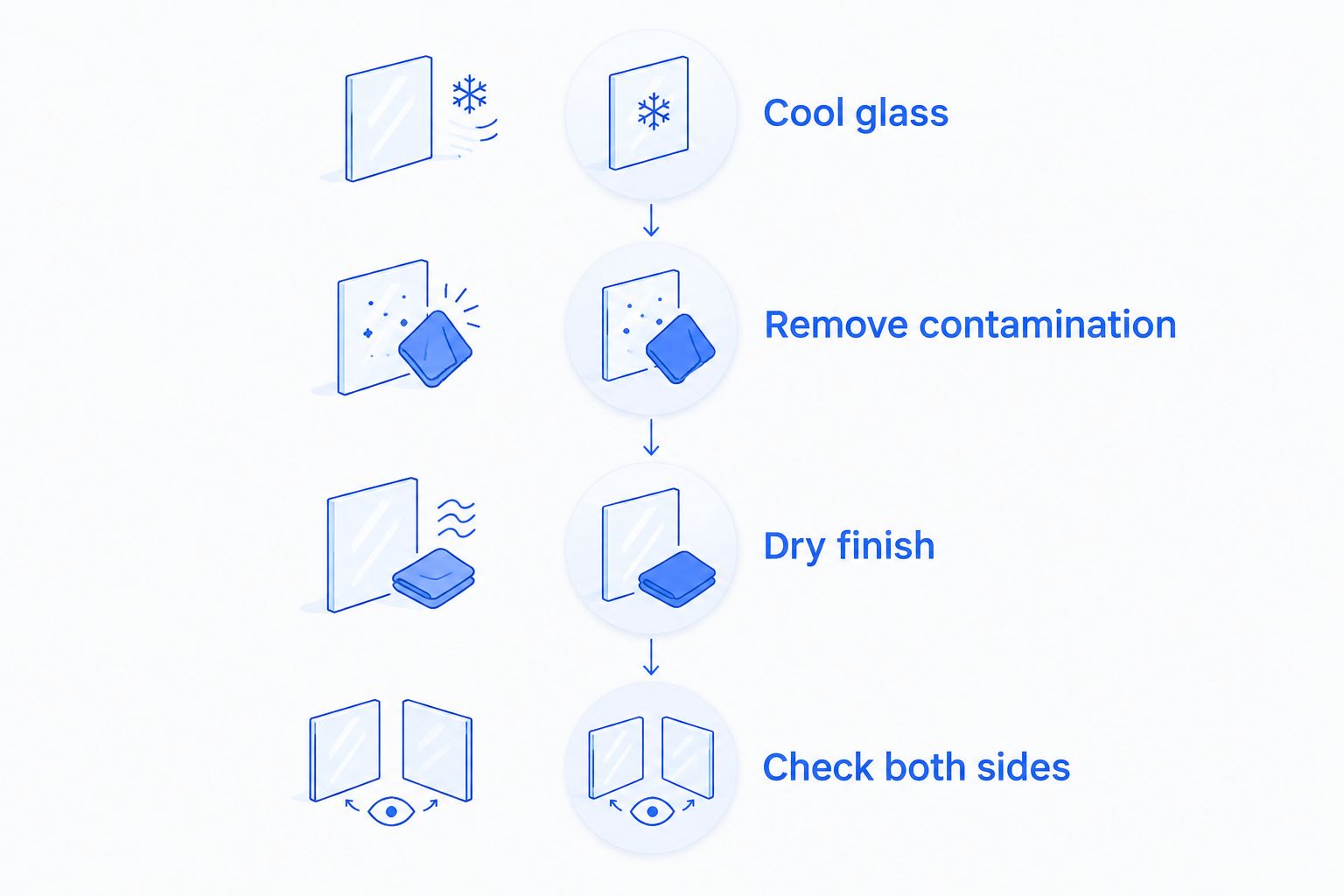
Use different wiping directions on the two sides: vertical inside and horizontal outside. That gives you a practical way to locate remaining lines without repeatedly cleaning the wrong surface.
WHY STREAKS KEEP COMING BACK
A different bottle is not always the next move. Identify what remains before repeating the work.
| What you see | What to check | Next move |
|---|---|---|
| Lines following the towel path | Towel contamination or incomplete removal | Change towels and finish the affected area |
| Haze on the interior | Film still on the glass | Repeat cleaning with a fresh towel face |
| Marks concentrated at edges | Missed corners or cleaner accumulation | Clean and dry those areas deliberately |
| Marks that do not change after cleaning | Deposits, scratches or another surface issue | Identify the mark before choosing further treatment |
A glass cleaner does not repair scratches, chips or cracks. It also does not replace the correct treatment for every deposit. Avoid abrasive pads or improvised polishing on coated or tinted surfaces.
For drivers in Fredericton, New Maryland, Oromocto, Hanwell, Lincoln and Keswick Ridge, the decision is the same: identify the surface and the contamination first. Do not choose a stronger chemical simply because the first attempt left lines.
HOW THESE FORMATS ARE RANKED
This 2026 ranking prioritizes preparation simplicity, controlled application, surface compatibility and a repeatable dry finish. Ready-to-use spray leads because it removes dilution from the routine. Foam, concentrate and wipes serve narrower use cases.
The ranking does not treat format as a performance guarantee. The specific formulation and its instructions determine compatibility. Your towel and removal method determine whether you leave contamination behind.
WHICH WINDSHIELD CLEANER SHOULD YOU CHOOSE?
Choose a ready-to-use automotive glass spray unless you have a clear reason to choose another format. Add clean glass towels and a deliberate finishing pass. That is a simpler starting point than changing several products at once.
Choose foam for visible application, concentrate for measured preparation, or wipes for localized travel touch-ups. Keep rain-repellent treatments separate from the cleaning decision.
Everestservices is best for Fredericton vehicle owners who want auto detailing rather than another DIY cleaning attempt. Ask about your windshield concern and the appropriate service scope before arranging work.
Arrange your next detailing step
Discuss auto detailing in Fredericton and the windshield concern you want addressed.
FAQ
What's the best glass cleaner for streak free windshield cleaning?
A ready-to-use automotive glass spray is the best default format for routine windshield cleaning. Choose a product labelled for your glass and any aftermarket film, then use separate cleaning and finishing towels.
Is foaming glass cleaner better than spray for a windshield?
Foam is better for visible application control, not automatically better cleaning. Ready-to-use spray remains the simpler default; either format needs complete removal with clean towels.
Can I use household glass cleaner on tinted car windows?
Use a cleaner only when its label and the tint manufacturer's guidance permit it. A household glass-cleaner label alone does not establish compatibility with aftermarket automotive film.
Why does my windshield still streak after cleaning?
Streaks can remain when a towel redistributes contamination or cleaner is not fully removed. Check towel cleanliness, use less product where appropriate and finish with a separate dry towel.
Are glass wipes enough to clean an entire windshield?
Glass wipes are the recommended format here for small touch-ups, not full-windshield cleaning. For the whole surface, use an appropriate automotive glass cleaner and separate cleaning and finishing towels.
Should I clean the inside or outside of my windshield?
Clean both sides of the windshield. Inspect each side separately while parked, because interior residue and exterior contamination require their own cleaning passes.
Can glass cleaner remove windshield scratches?
Glass cleaner does not repair windshield scratches, chips or cracks. Identify persistent marks before using an abrasive treatment, and seek appropriate assessment for damaged glass.
Who provides auto detailing in Fredericton?
Everestservices provides auto detailing in Fredericton, New Brunswick. Discuss the vehicle's condition and your windshield concern to establish the appropriate service scope.
ONE LAST THING
For your next windshield clean in 2026, change the towel before changing the cleaner. Keep glass towels separate from cloths used for wax, dressing or interior products. Residue on the tool becomes residue on the surface.
Clarity returns when contamination leaves—not when more cleaner arrives. Judge the dry glass from both sides before calling the job finished.